
The Snowball Analytics
FIRE Calculator
Calculate your Financial Independence (FI) number, years to early retirement, CoastFIRE age, and estimated monthly withdrawal on an interactive chart.
The FIRE calculator helps you work out:
FIRE Target & Portfolio Number
Your required total net worth to achieve full financial independence based on your withdrawal rate (4% by default).
CoastFIRE Target Age
The age when your current nest egg will grow to your FIRE target without any further contributions.
Safe Withdrawal Payouts
Monthly and annual income your FIRE number could support at your chosen withdrawal rate.
LeanFIRE vs. FatFIRE
Compare lower and higher spending targets, adjusted for the inflation rate you set.
FI Target Nest Egg
Years to FIRE · Age 51.8
CoastFIRE Age (to 65)
Monthly payout
today's $ · ≈ $4,285 in FI-year $
LeanFIRE and FatFIRE are illustrative multiples of your FIRE number, not spending-based benchmarks.
Illustrative projection from your inputs: 8% annual return before inflation, 2.5% inflation, 4% withdrawal rate. Monthly savings stay at the entered amount unless you set a step-up. Results are in today's dollars unless marked nominal. This is arithmetic, not a forecast or advice. Investments can lose value.
Pro-Tips for Early Retirement (FIRE)
Actionable strategies to accelerate financial independence, protect safe withdrawal rates, and prevent portfolio depletion.
Define Your Target Base
Multiply your annual post-retirement living expenses by 25 (based on the 4.0% Safe Withdrawal Rate). For early retirements exceeding 30 years, consider a lower rate such as 3.25%–3.5% (about 29x–31x expenses) to allow for longer horizons and weaker markets.
Build a 2-Year Cash Buffer
Protect against Sequence of Returns Risk by holding 2–3 years of living expenses in short-term yield or cash buffers during early retirement. This can reduce the need to sell equities at a loss during market downturns.
Leverage CoastFIRE Milestones
Once your portfolio reaches its CoastFIRE number, growth alone is projected to reach your FI target by the age you chose, assuming the return you entered. You would still need income to cover your current expenses.
More Financial Tools & Calculators
Optimize your portfolio further with our specialized long-term planning tools.
Dividend Calculator
Project future dividend payouts, simulate DRIP plans, and calculate your Yield on Cost.
Compound Interest Calculator
Simulate daily compound growth, model savings timing, tax drag, inflation, and volatility.
Retirement Calculator
Plan your post-career nest egg, track spending thresholds, and build income runways.
S&P 500 Return Calculator
Simulate real historical S&P 500 returns (1970–2025) with DRIP and CPI inflation.
Explore the Snowball Analytics ecosystem
Dive deeper into the tools behind the tracker — from stock analysis to dividend planning
Dividend tracker
Automatically track payouts, calculate Yield on Cost, and project future passive income.
Explore dividend tracker →Dividend rating
Avoid yield traps. Analyze financial health,payout ratio and sustainability.
Check dividend ratings →Stock tracker
Monitor individual equities, price movements and 10-year company fundamentals.
Explore stock tracker →Dividend calendar
See exactly when payouts hit your account across all global holdings.
View dividend calendar →Dividend calculator
Project future passive income, simulate DRIP scenarios and visualize compounding.
Try dividend calculator →Ex-dividend calendar
See upcoming ex-dividend and payment dates for your holdings.
View ex-dividend dates →FIRE Calculator with Inflation, Tax Drag and Custom SWR
Many simple early retirement calculators skip inflation and taxes. The Snowball Analytics FIRE Calculator adds inflation discounting, tax drag and a custom withdrawal rate to the 4% rule from the Trinity Study, so you can estimate when financial independence could be reached. It is an illustration based on your assumptions, not a forecast.
FIRE Calculator Comparison: Snowball Analytics vs. FinMango and Portseido
How this calculator compares with two popular free FIRE calculators, based on what each tool shows publicly.
| Feature | Snowball Analytics | FinMango | Portseido |
|---|---|---|---|
| FIRE number from expenses and a custom withdrawal rate | SWR 2–8% | SWR 3–5% | ✕ growth projection only |
| Inflation-adjusted results in today's dollars | inflation rate input | real return input | ✕ |
| Tax drag on returns | ✕ | ✕ | |
| Monthly savings that grow each year (step-up) | ✕ | ||
| Lean, Standard and Fat targets with the age you reach each | Targets only, no ages. Also shows Barista | ✕ separate calculators | |
| CoastFIRE with an adjustable retirement age | Fixed at age 65 | ✕ separate calculator | |
| Savings needed to reach your target retirement age | ✕ shows years to FIRE | ✕ | |
| Year-by-year table | ✕ chart only | ||
| CSV export of the projection | ✕ | ✕ | |
| Link to a portfolio tracker | Snowball Analytics tracker | ✕ no account | Portseido tracker |
Compared in October 2026 using the public versions of FinMango and Portseido. ✕ means the feature is not shown among the tool's inputs and outputs. Tools change over time, so check each one for current details.
How to Calculate Your FIRE Number
Your FIRE number is the portfolio size at which your investments could cover your yearly spending. Divide your expected annual expenses in retirement by your withdrawal rate: FIRE number = annual expenses ÷ withdrawal rate.
For example, $30,000 of annual expenses at a 4% withdrawal rate gives $30,000 ÷ 0.04 = $750,000 (the “rule of 25”). A lower rate such as 3.5% raises the target to about $857,000. The calculator above shows the figure in today's dollars and estimates how many years it could take to reach it with your savings, return and inflation assumptions.
Understanding the FIRE Movement (Financial Independence, Retire Early)
The FIRE Movement is a financial philosophy centered on extreme savings and purposeful investing to gain control of your time long before traditional retirement age (65). By decoupling income from traditional 9-to-5 labor, FIRE practitioners build a self-sustaining asset base that aims to fund living expenses over the long term.
The Core Pillars of Early Retirement
- High Savings Rate: While traditional financial advice recommends saving 10% to 15% of income, FIRE followers often aim to save a much larger share, in many cases 30% or more, to shorten the accumulation phase considerably.
- The 4% Safe Withdrawal Rate (SWR): Derived from the famous Trinity Study, the 4% rule states that a balanced portfolio of stocks and bonds historically sustained an annual withdrawal of 4% of its initial value (adjusted for inflation) through most of the 30-year periods tested in the 1998 Trinity Study (Cooley, Hubbard & Walz). Past results do not guarantee future outcomes.
- The Rule of 25: Your target Financial Independence (FI) number is calculated as 25 times your expected annual living expenses ($30,000 × 25 = $750,000).
LeanFIRE vs. Standard FIRE vs. FatFIRE vs. CoastFIRE
Not everyone envisions retirement the same way. The FIRE movement includes four major sub-strategies based on spending goals and lifestyle choices:
- LeanFIRE (Frugal Horizon): Achieving FI with low annual expenses, commonly described as below about $40,000 (a community convention, not a rule). At a 4% withdrawal rate that means a nest egg of up to about $1,000,000. In this calculator, the LeanFIRE milestone is 75% of your FIRE number.
- Standard FIRE (Comfortable Baseline): Achieving FI with typical living expenses ($40,000–$80,000/yr), which at a 4% withdrawal rate means a $1,000,000–$2,000,000 portfolio.
- FatFIRE (Abundant Lifestyle): Early retirement with annual spending over $100,000, maintaining travel, luxury, and a strong financial buffer ($2,500,000+ nest egg at a 4% withdrawal rate).
- CoastFIRE (Compound Momentum): Reaching a portfolio size where compound growth alone is projected to carry you to your target FI number by the age you choose (65 by default) without depositing another dollar. Set that age in the “CoastFIRE: Age You Coast To” field.
Pro-Tip: Living on Dividends for FIRE
Instead of liquidating 4% of your portfolio shares each year during market downturns, dividend FIRE practitioners build a dividend-focused portfolio (for example dividend ETFs or dividend growth stocks, as an illustration and not a recommendation). Their living income is paid mainly out of dividend cash flow, leaving underlying shares untouched. Dividends are not guaranteed and can be cut.
Frequently Asked Questions about FIRE
Your portfolio dashboard, anywhere
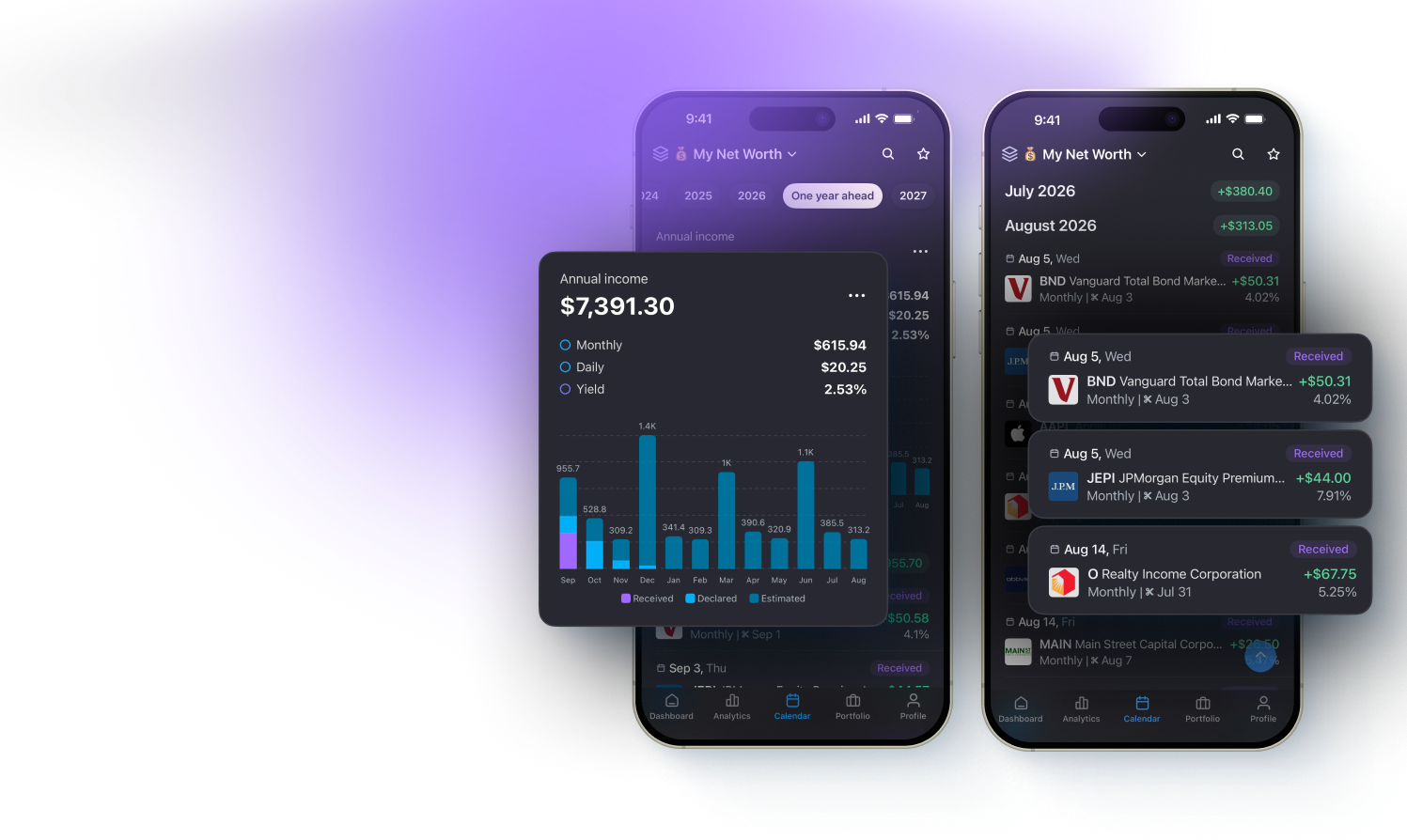
Take control of your investments with the Snowball Analytics mobile app. Everything you love about the web tracker, fully optimized for your smartphone.