

Disclaimer: Information only. Not financial, tax, or legal advice. Consult a CPA or financial advisor for your specific situation.
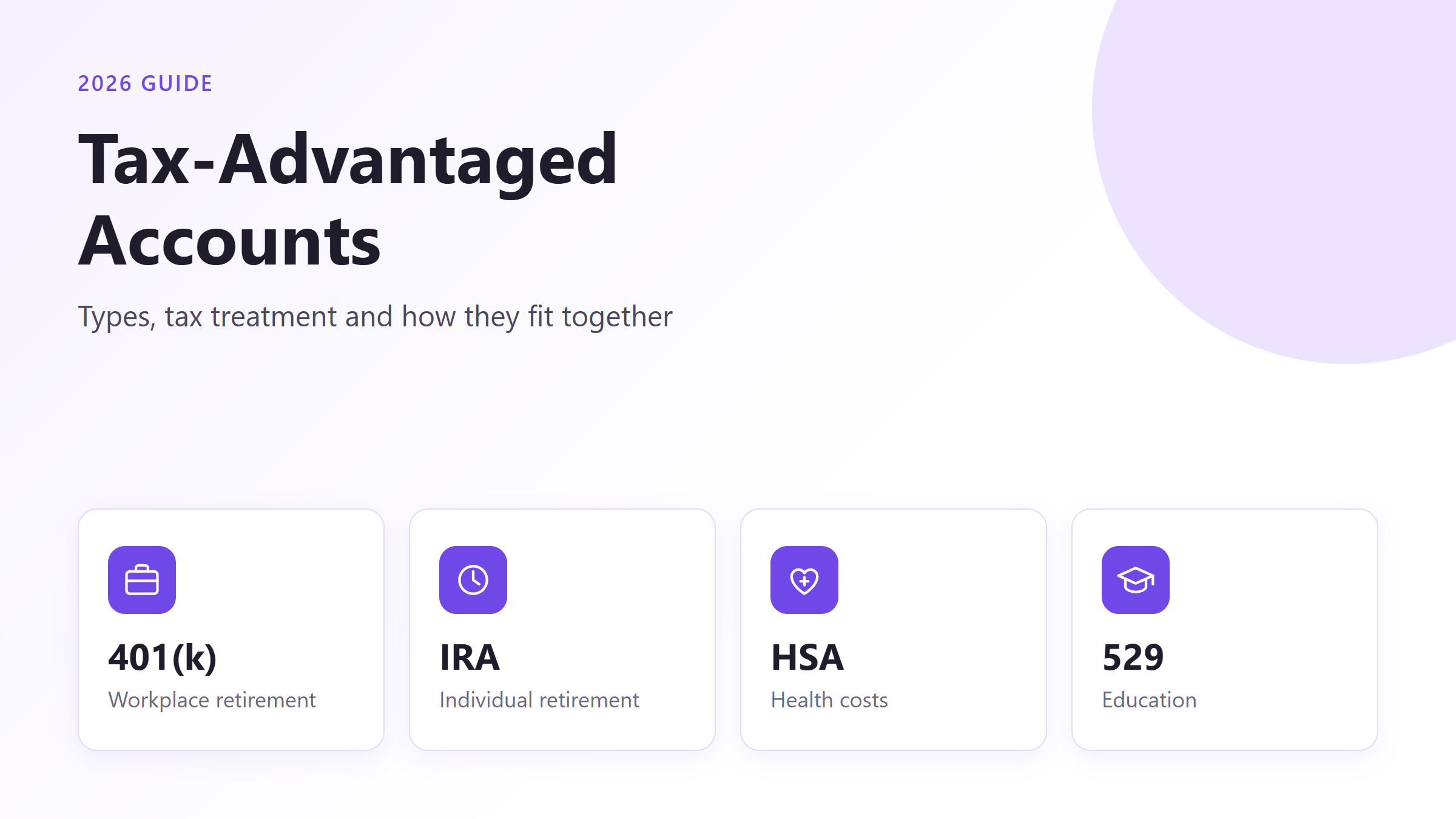
Taxes paid along the way reduce the money left to compound. A standard taxable brokerage account generates annual taxes on dividends and realized capital gains, while tax-advantaged accounts such as 401(k)s, IRAs, HSAs, and 529 plans change when and whether those taxes are paid. The primary challenge for many investors is not finding these accounts. It is understanding how to layer and sequence them efficiently. Investments can lose value.
The Big Picture: Tax-Advantaged Accounts
| Account | Main tax treatment | 2026 limit | Source |
|---|---|---|---|
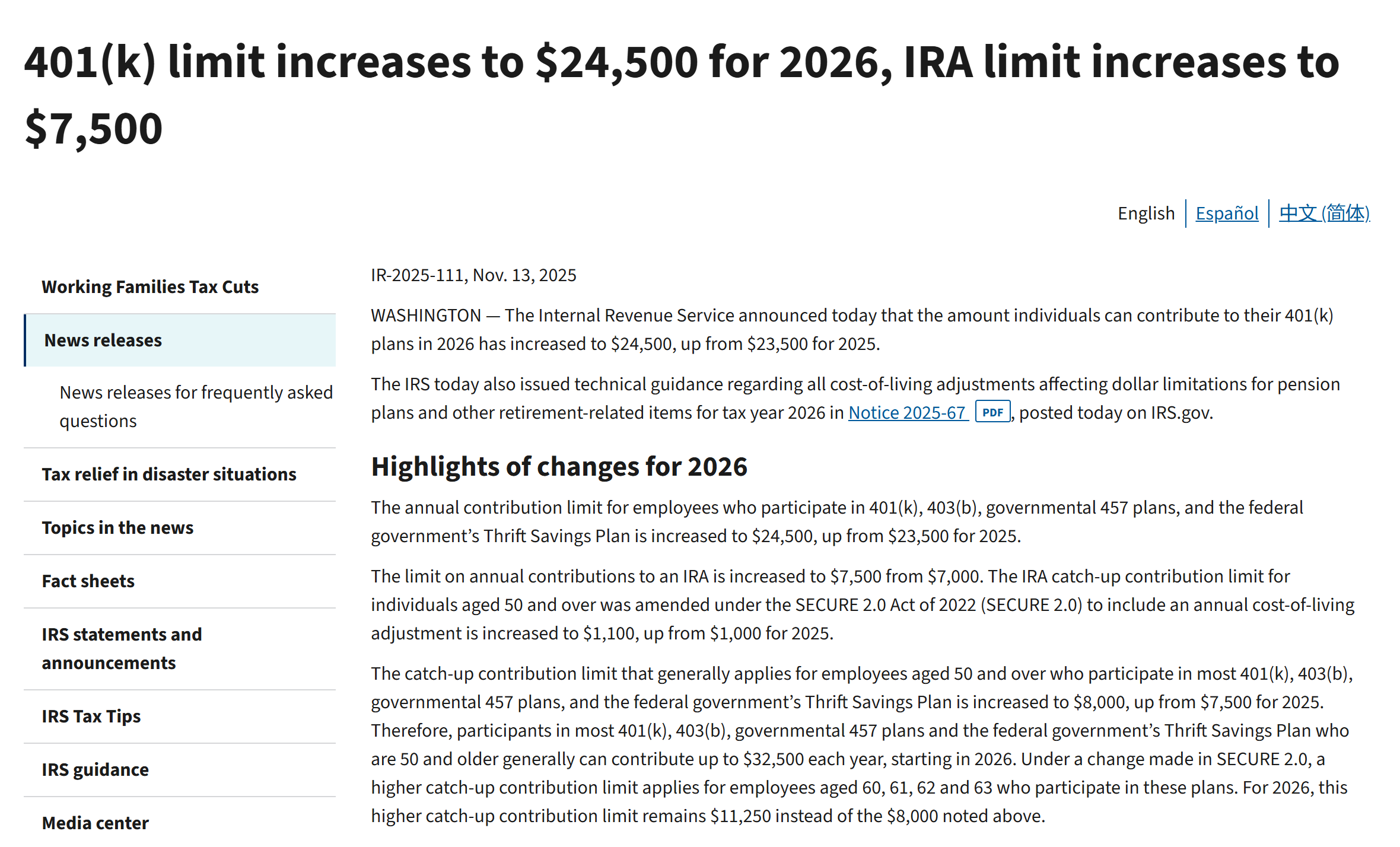
| 401(k), 403(b), governmental 457(b) | Traditional: tax-deferred. Roth: tax-free if qualified. | $24,500 employee limit, plus $8,000 catch-up at 50 and older ($11,250 at ages 60 to 63). Total plan limit of $72,000, not counting catch-up. | IR-2025-111; IRS COLA table |
| Traditional and Roth IRA | Traditional: tax-deferred. Roth: tax-free if qualified. | $7,500, or $8,600 at 50 and older, across all IRAs combined | IR-2025-111 |
| HSA | Deductible contributions, tax-free growth, tax-free qualified medical withdrawals | $4,400 self-only, $8,750 family, plus $1,000 at 55 and older. HDHP minimum deductible of $1,700 (self-only) or $3,400 (family). | IRS Publication 969; Notice 2026-05 |
| 529 plan | After-tax contributions, no federal deduction, tax-free if used for qualified education expenses | Each plan sets its own aggregate limit. K-12 withdrawals up to $20,000 per beneficiary per year. | 26 U.S.C. §529 |
| SEP IRA | Tax-deferred | The lesser of 25% of compensation or $72,000 (for self-employed owners, about 20% of net self-employment earnings) | IRS, SEP contribution limits; Pub. 560 |
| SIMPLE IRA | Tax-deferred | $17,000, plus $4,000 catch-up at 50 and older ($5,250 at ages 60 to 63). Some smaller employers' plans allow higher limits. | IRS, SIMPLE IRA plan |
| Solo 401(k) | Traditional: tax-deferred. Roth: tax-free if qualified. | $24,500 as the employee, plus employer contributions of up to 25% of compensation (reduced rate for self-employed owners), up to $72,000 in total, plus catch-up | IRS, One-participant 401(k) plans; Pub. 560 |
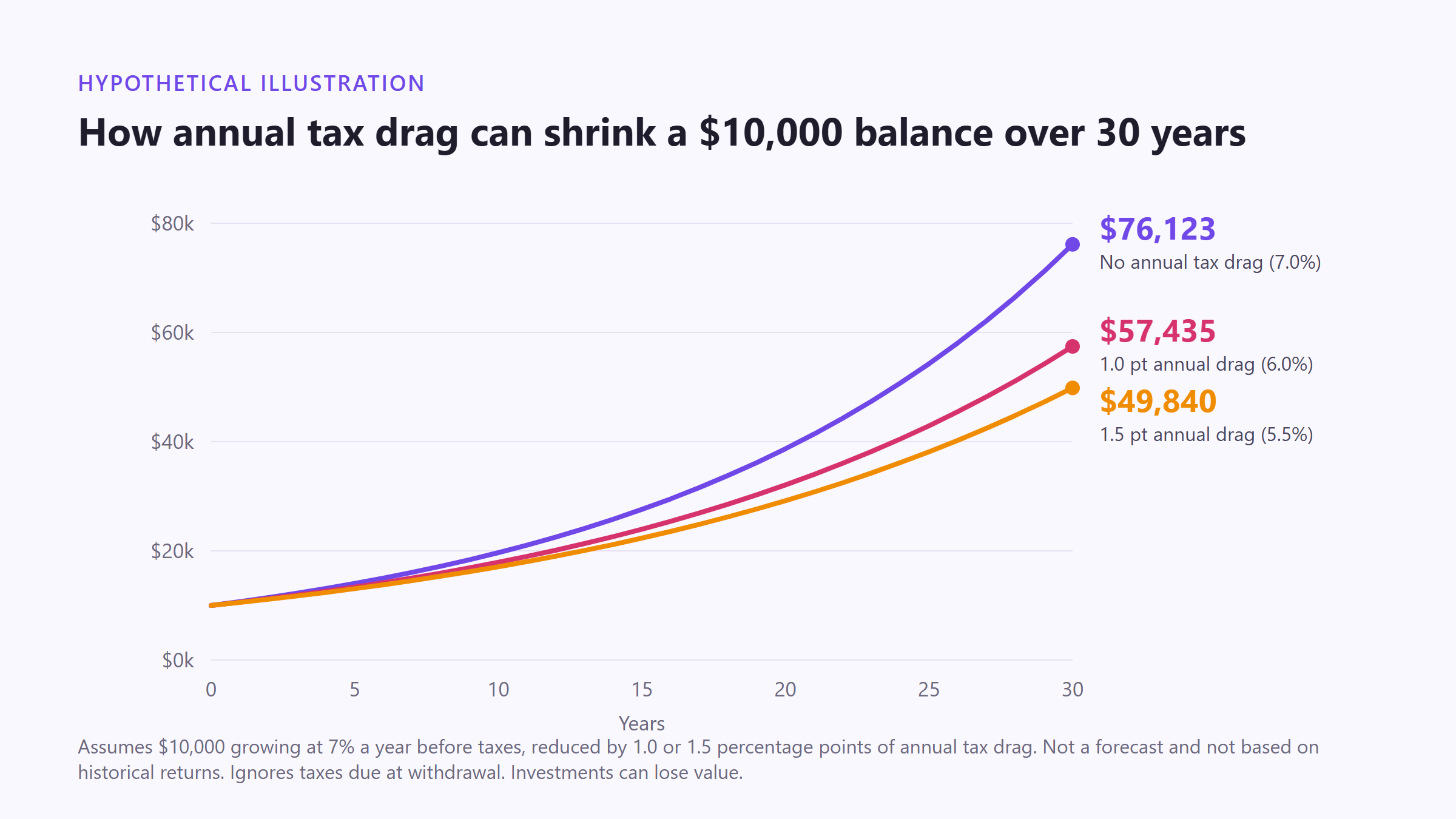
To understand why account structure matters, consider how taxes erode long-term returns. In a taxable brokerage account, you pay capital gains taxes every time you rebalance or sell an asset for a profit. You also pay income taxes on cash dividends every single year, regardless of whether you withdraw the cash or reinvest it.
This annual leakage is known as tax drag. Hypothetical example: assume a portfolio grows 7% a year before taxes. If taxes and rebalancing cost 1.0 percentage point of that return each year, the portfolio ends a 30-year period roughly 25% smaller than one with no tax drag. At 1.5 percentage points, it ends roughly 35% smaller. These figures are illustrations, not forecasts, and are not based on historical returns. Actual tax drag depends on your holdings, tax bracket, and trading. Tax-advantaged accounts change the timing of taxes, so dividends, interest, and capital gains inside them are not taxed each year. Withdrawals may be taxed later, depending on the account.
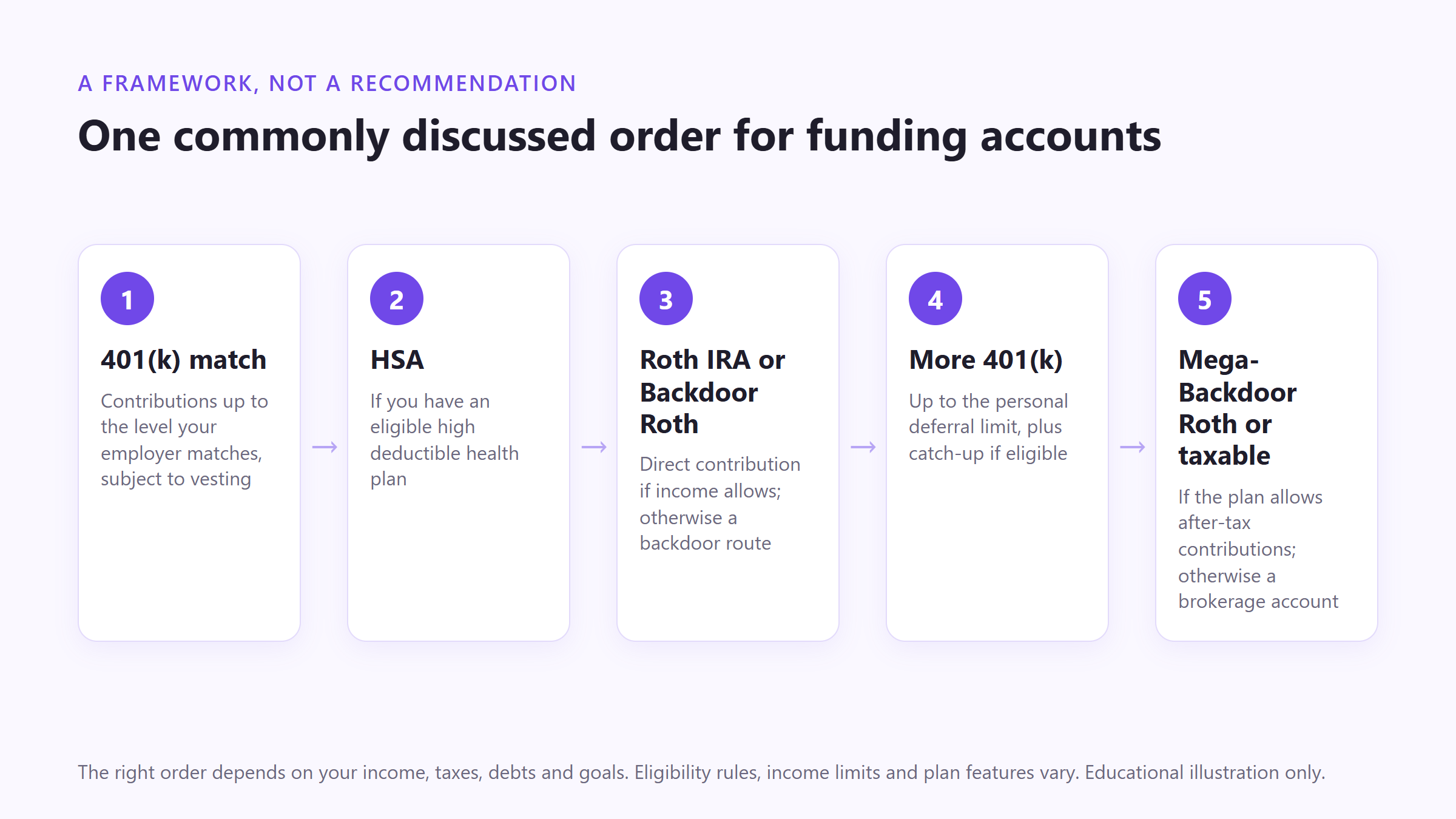
Putting savings into accounts at random can mean missing benefits you were eligible for. One commonly discussed order for funding accounts is below. It is a framework, not a recommendation, and the right order depends on your income, taxes, debts, and goals:
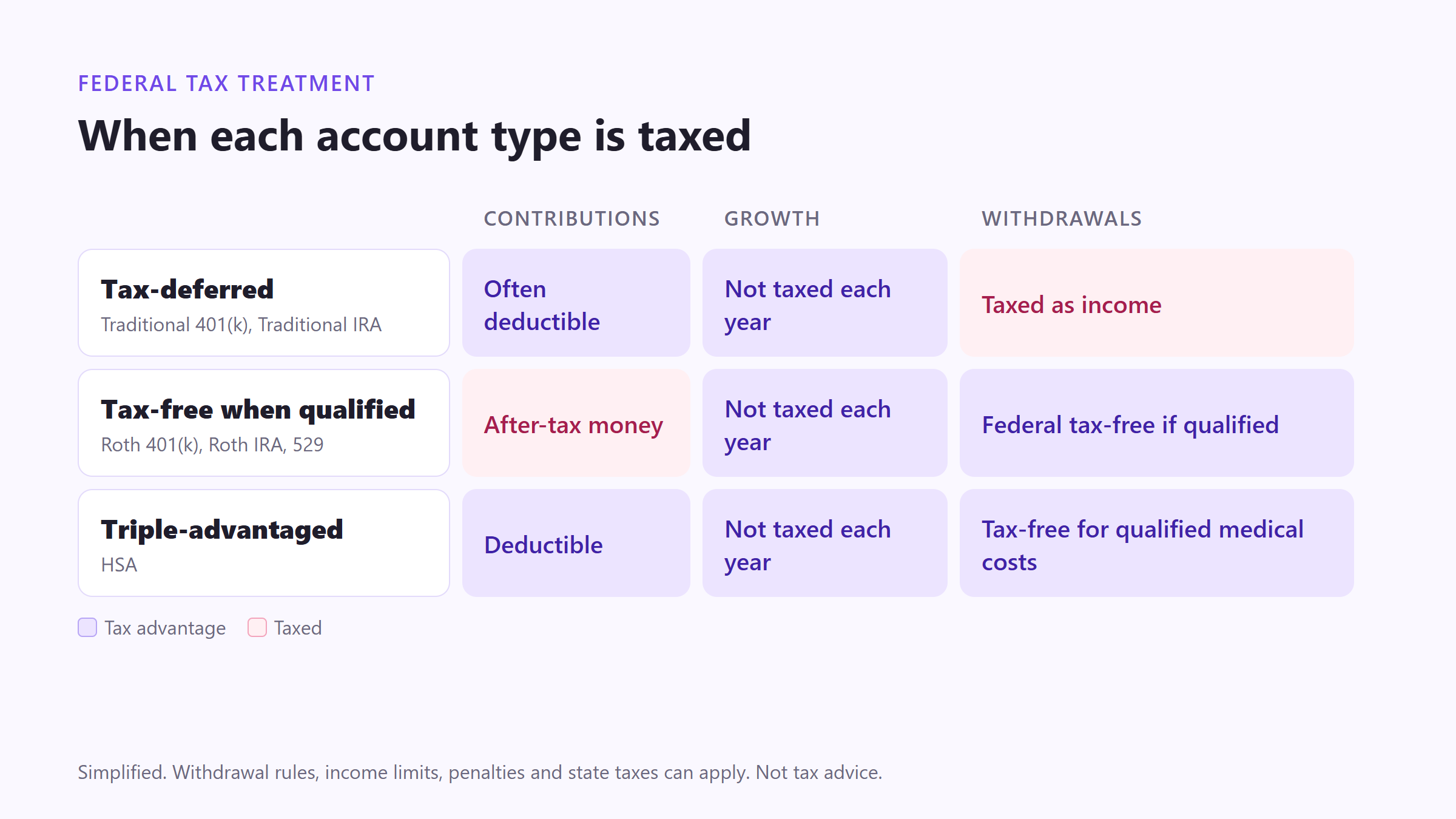
Tax code mechanics divide these accounts into three primary buckets. Understanding how each bucket handles tax timing helps you match assets to the right accounts:
| Mechanism | Tax Timing | Core Benefit | Primary Vehicles |
|---|---|---|---|
| Tax-Deferred | Contributions may be deductible today; withdrawals are taxed as income | Lowers current taxable income when deductible, and growth is not taxed each year | Traditional 401(k), Traditional IRA (including growth on nondeductible contributions) |
| Tax-Free on Qualified Withdrawals | Contributions are made with after-tax dollars | Growth and qualified withdrawals are free of federal income tax | Roth 401(k), Roth IRA, 529 plans (for qualified education expenses) |
| Triple-Advantaged | Deductible contributions, tax-free growth, and tax-free withdrawals for qualified medical expenses | Three tax advantages in a single account | HSA |
Employer-sponsored plans anchor most retirement portfolios, but the exact account mechanics change based on your employment setup.
W-2 employees generally use 401(k)s, 403(b)s (common in healthcare and education), or the federal Thrift Savings Plan (TSP). Governmental 457(b) plans have a unique feature: distributions are generally not subject to the 10% additional tax, even before age 59½, once you leave your employer (income tax still applies). The exception is amounts rolled into the 457(b) from other types of plans.
Business owners and 1099 freelancers can use plans with higher contribution ceilings:
When your income exceeds the phaseout limits for direct Roth IRA contributions, high-earner conversion strategies provide an alternative entrance.
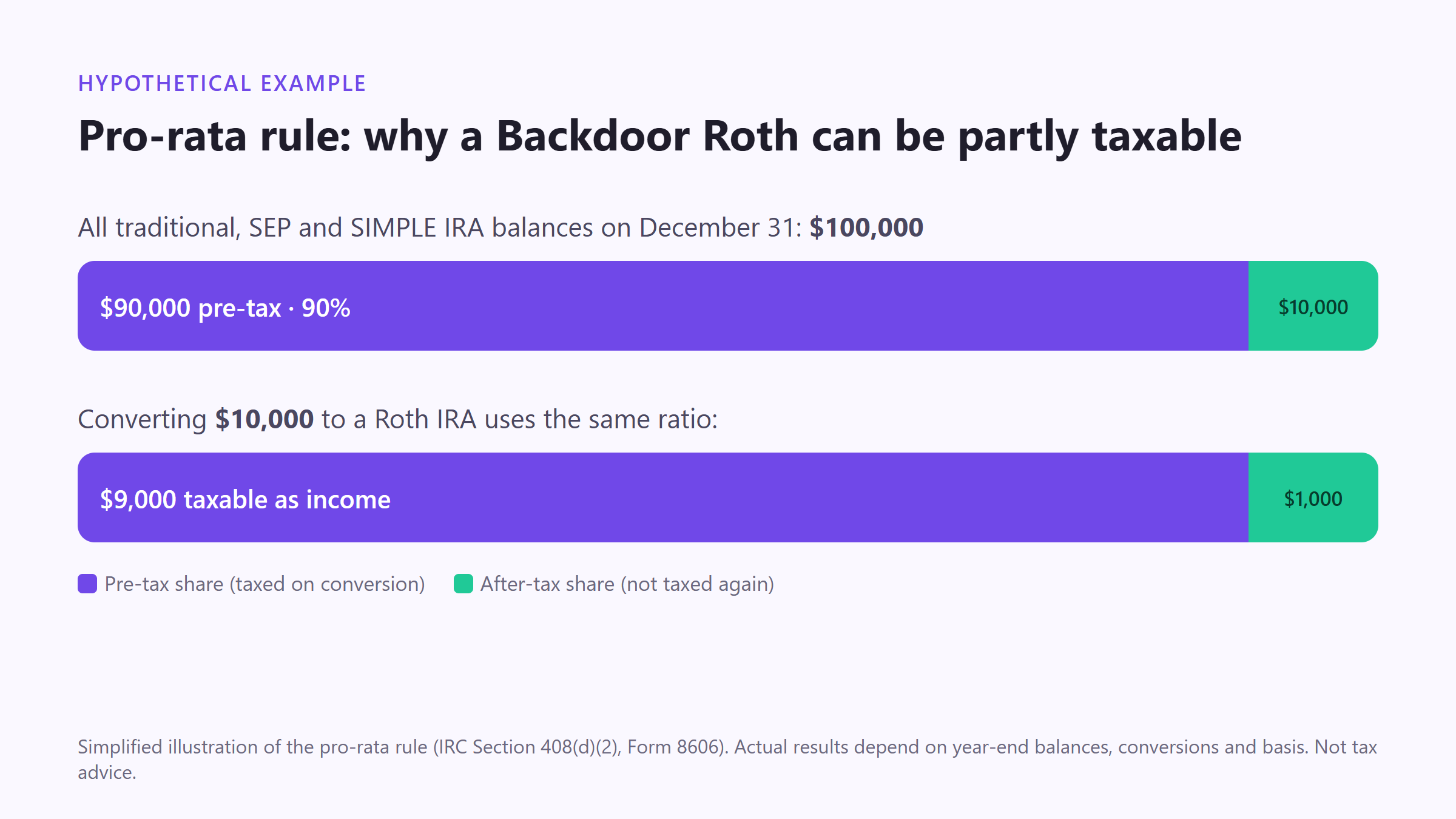
Math Example: The Pro-Rata Rule (IRC Section 408(d)(2)): The IRS does not allow you to convert only the non-deductible dollars if you own other pre-tax IRAs. The share is measured across your traditional, SEP, and SIMPLE IRA balances as of December 31 of the conversion year. For instance, if you hold $90,000 in a pre-tax Traditional IRA and add $10,000 of post-tax money, 90% of your total IRA balance is pre-tax, so 90% of a $10,000 conversion ($9,000) is taxable. Some people reduce this by rolling pre-tax IRA balances into a workplace 401(k) before converting, if the plan accepts rollovers.
If your employer's 401(k) plan permits after-tax contributions (distinct from Roth contributions) and allows in-plan Roth conversions or in-service withdrawals, a Mega-Backdoor Roth may be possible. The room available is the overall plan limit ($72,000 for 2026, excluding catch-up contributions) minus your own deferrals and any employer contributions. The after-tax amounts can then be moved into a Roth 401(k) or Roth IRA. Plans differ, so check what yours allows.
Using several account types at once adds rules that interact. These points commonly cause surprises:
Specialized accounts designed for medical or education costs can also play a role in longer-term planning.
An HSA offers three tax advantages. Paying routine medical bills from the HSA reduces the balance that could keep growing. Some HSA holders pay current bills out of pocket, scan and save digital receipts in a "shoebox" folder, and leave their HSA funds invested. Investments can lose value, and this approach depends on being able to afford the out-of-pocket costs.
Some HSA holders reimburse themselves years later. That requires that the expense was incurred after the HSA was established (expenses before that date are not qualified), was not reimbursed from another source, and is supported by records. Qualified expenses include dental work, vision care, prescription glasses, COBRA premiums, and Medicare premiums after age 65 (Medigap premiums do not qualify).
State 529 plans let college savings grow without annual taxes, and withdrawals for qualified education expenses are free of federal income tax. More than 30 states offer state income tax deductions or credits for contributions. Starting in 2026, up to $20,000 per beneficiary per year can also be used for qualified K-12 expenses.
Under the SECURE 2.0 Act, families who overfund a 529 have another option: up to $35,000 of unused 529 funds can be rolled into the beneficiary's Roth IRA over their lifetime. The 529 account must have been maintained for at least 15 years, contributions from the last 5 years (and the earnings on them) cannot be rolled over, each year's rollover is limited to the annual Roth IRA contribution limit ($7,500 for 2026) reduced by any other IRA contributions for that year, and generally cannot exceed the beneficiary's taxable compensation for the year (the usual Roth IRA income limits do not apply). The transfer must be made directly from the 529 to the Roth IRA. Your state may tax the rollover.
Health Savings Accounts have their own limits and eligibility rules, and 2026 brought several changes.
Under the One Big Beautiful Bill Act and IRS Notice 2026-05:
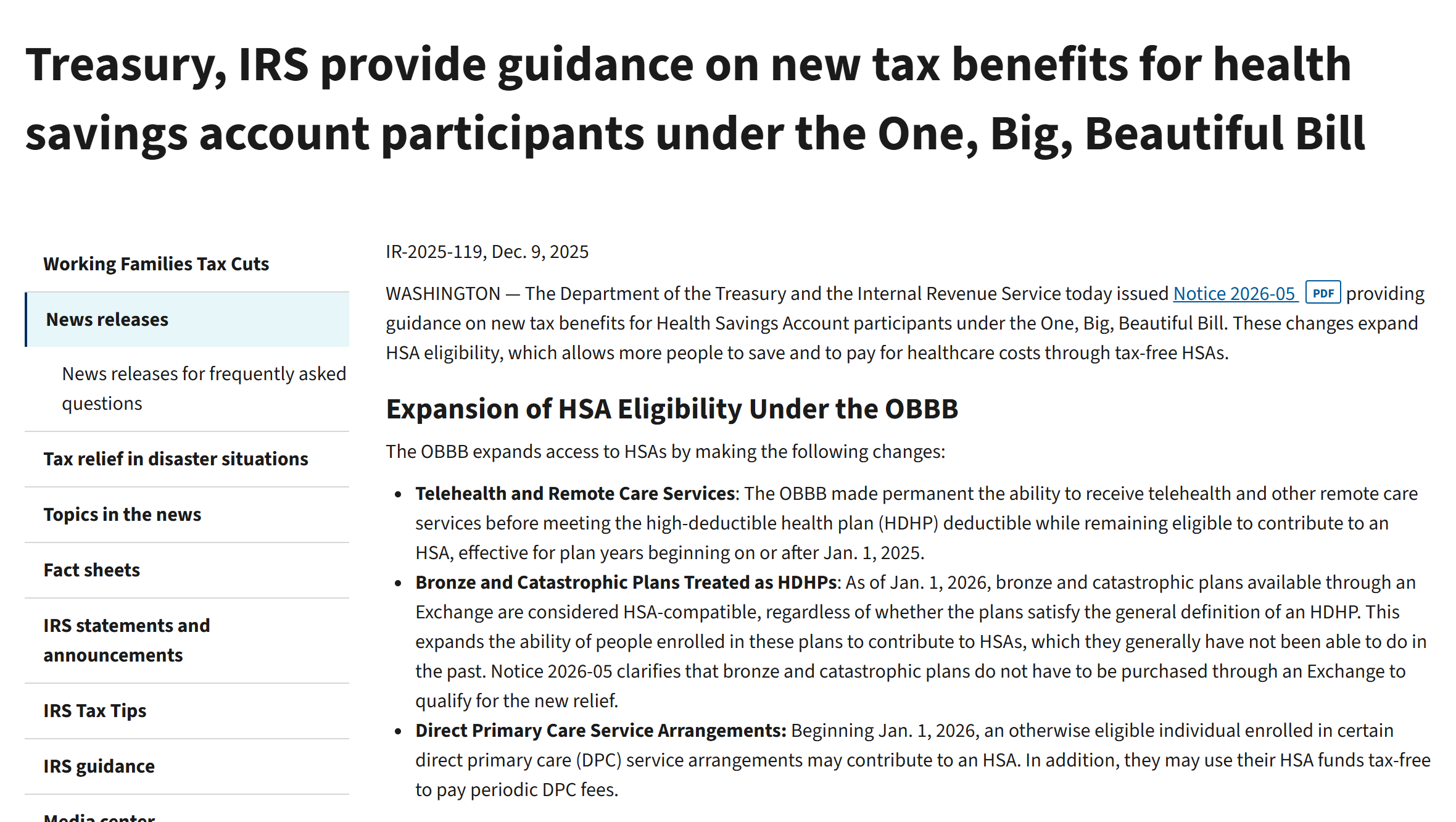
The IRS accepted public comments on Notice 2026-05, so details may be refined. Check the current guidance before relying on a specific plan or arrangement.
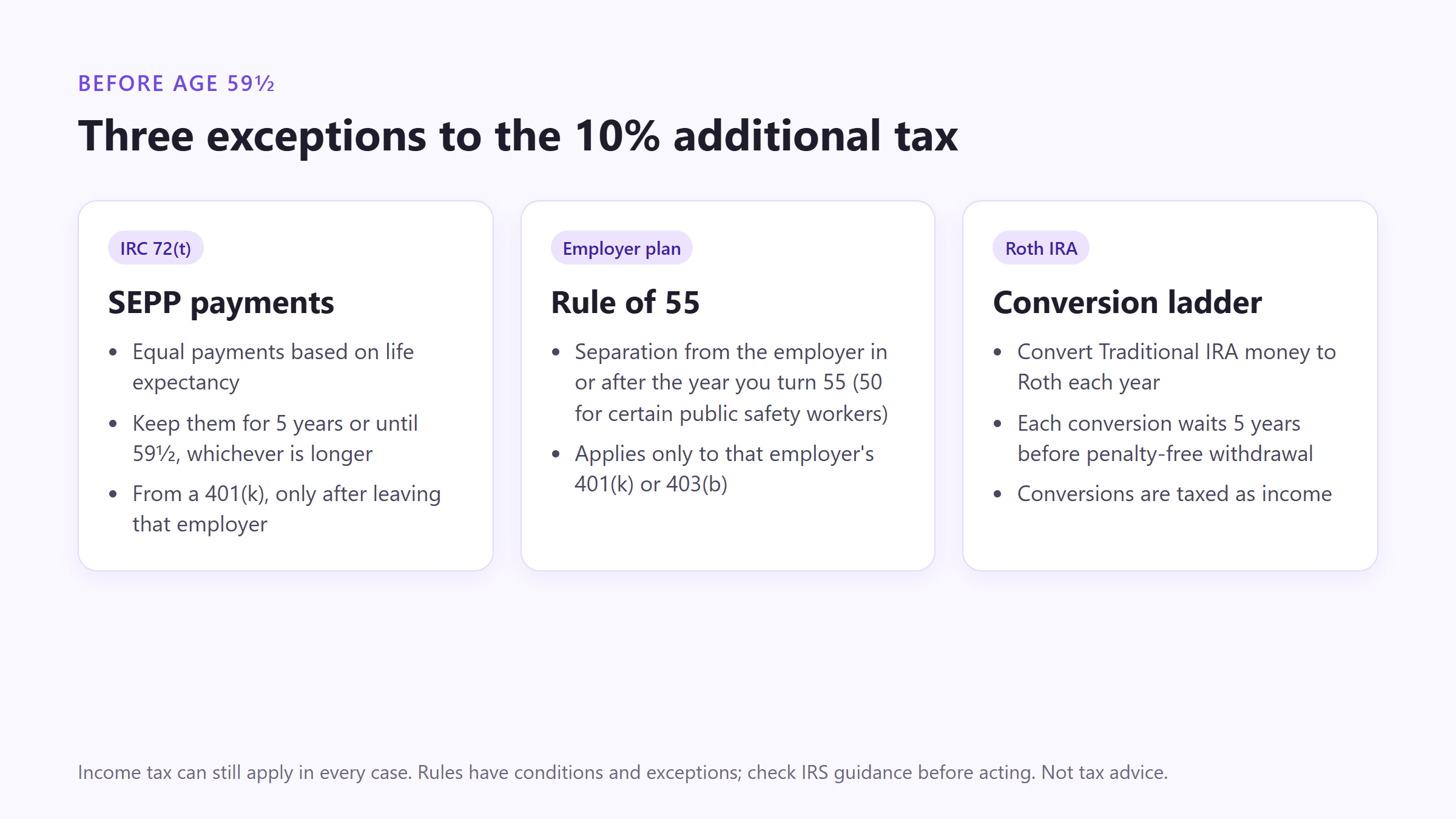
A common misconception is that retirement accounts are completely locked until age 59½. Early retirees (FIRE movement) sometimes use three mechanisms to avoid the 10% additional tax, though income tax can still apply:
Pre-tax accounts cannot stay tax-deferred forever. Required Minimum Distributions (RMDs) start at age 73 for people born from 1951 through 1959, and at age 75 for those born in 1960 or later (as reflected in IRS proposed regulations issued in 2024).
Large pre-tax distributions can push retirees into higher tax brackets, trigger Medicare IRMAA premium surcharges, and increase the portion of Social Security income that is taxed (up to 85%). Once you turn 70½, Qualified Charitable Distributions (QCDs) let you transfer up to $111,000 in 2026 directly from your IRA to charity. A QCD can count toward your RMD and is excluded from your taxable income.
Inherited IRA 10-Year Rule: Under the SECURE Act, most designated beneficiaries (individuals named as beneficiaries) who inherit a traditional or Roth IRA must empty the account within 10 years of the original owner's death. Exceptions apply to eligible designated beneficiaries: a surviving spouse, a minor child of the owner, a disabled or chronically ill person, and a person not more than ten years younger than the owner. If the owner had already started taking RMDs, annual distributions may also be required before the 10-year deadline, so check IRS Publication 590-B for the rules that apply. Inherited Roth IRAs generally have no annual distribution requirement during the 10 years, but the account must be emptied by the end of that period. Spreading inherited pre-tax distributions across those years can help avoid a large single-year tax bill.
Asset location is the practice of holding different kinds of investments in different account types, based on how each is taxed. The points below are general considerations, not recommendations:
Federal tax treatment does not always carry over to state returns, so an account that is tax-advantaged on your federal return can be taxed differently at the state level.
State rules change, so check your state tax agency's current guidance.
Tax-advantaged accounts differ mainly in when taxes are paid, what the money can be used for, and which limits and conditions apply. Retirement accounts, HSAs, and 529 plans each serve a different purpose, and details such as income limits and withdrawal rules can change what an account is worth to you. Check current limits at IRS.gov, and consider speaking with a tax professional before acting on any of the strategies above.
Disclaimer: Information only. Not financial, tax, or legal advice. Consult a CPA or financial advisor for your specific situation. This material is educational and general in nature and does not consider your individual circumstances. Snowball Analytics is a portfolio-tracking tool. It is not a registered investment adviser, broker-dealer, or tax preparer. Figures reflect federal limits for tax year 2026, checked on 2026-10-22. IRS rules and contribution limits change periodically, so verify at IRS.gov.