

Getting your first job offer or reviewing a new HR packet can feel like a lot of financial jargon. Among all those acronyms, one of the most common is the 401(k). At its simplest, a 401(k) is a specialized savings account that lets you take cash straight from your paycheck, invest it before or after taxes, and build long-term savings for retirement. Many employers also add matching contributions when you contribute. Investments can lose value.
Quick Answers: 401(k) at a Glance
| Item | 2026 rule | Source |
|---|---|---|
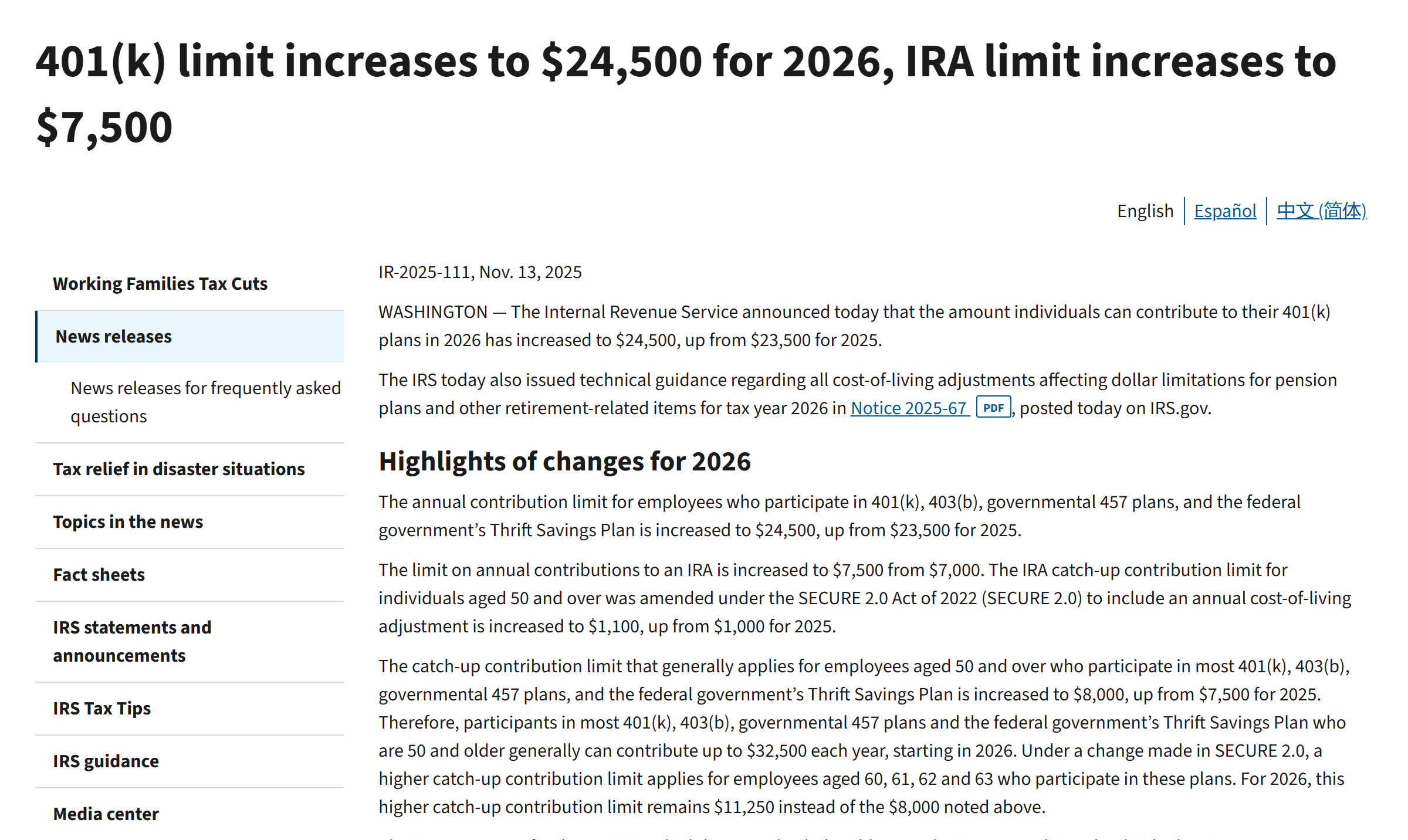
| Employee contribution limit | $24,500 (was $23,500 in 2025) | IRS IR-2025-111 |
| Catch-up, age 50 and older | $8,000 (personal total $32,500) | IRS, Catch-up contributions |
| Catch-up, ages 60 to 63 | $11,250 instead of $8,000 (personal total $35,750) | IRS, Catch-up contributions |
| Total limit, employee plus employer | $72,000, not counting catch-up (was $70,000) | IRS, COLA increases (IRC 415(c)) |
| Roth catch-up requirement | Applies if your prior-year wages from the plan sponsor were above $150,000 | IRS, Catch-up contributions; IR-2025-91 |
| Plan loan | Lesser of 50% of your vested balance or $50,000, if the plan allows loans (some plans allow up to $10,000 if 50% of your balance is less than that) | IRS, Retirement topics: Loans |
| Plan cash-out limit for small balances | A plan can only force out balances of $7,000 or less | 26 U.S.C. §411(a)(11) |
Imagine setting up an automatic transfer that funds your future self before your monthly bills even hit your checking account. That is the core mechanism of a 401(k). You pick a percentage of your salary (say, 5% or 10%) and your employer routes that money directly into your investment account each payday.
Because the money leaves your paycheck automatically, saving does not depend on remembering to transfer cash every month. Over time, those steady payroll contributions buy shares of investments that can generate dividends and capital gains, so contributions and any growth can build on each other over time (compound growth).
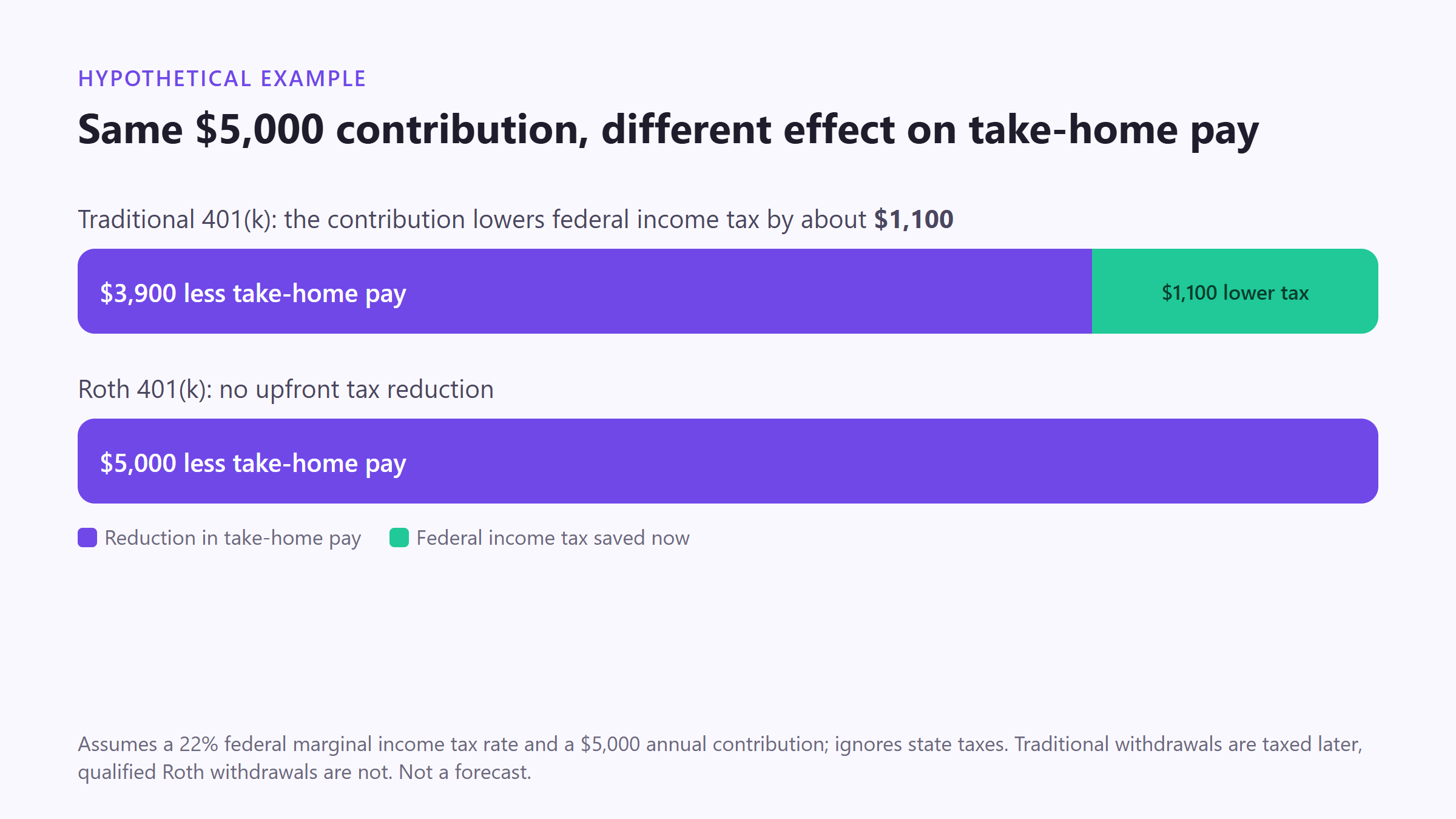
When you use pre-tax dollars, you get an immediate federal income tax break. Hypothetical example: if you earn $60,000 a year and contribute $5,000 to a traditional 401(k), your federal taxable wages drop to $55,000 (Social Security and Medicare taxes still apply to the full $60,000). That means you pay less income tax today, and the money is taxed later when you withdraw it.
Many employers offer two versions of the 401(k). The main difference is a timing choice: Do you want your tax break now, or tax-free qualified withdrawals in retirement?
| Feature | Traditional 401(k) | Roth 401(k) |
|---|---|---|
| Tax Timing | Pay taxes later when you take money out in retirement. | Pay taxes now on your current paycheck before depositing. |
| Upfront Benefit | Lowers your current tax bill: Contributions reduce your reported income for the current year. | No current tax break: Your paycheck taxes stay exactly the same. |
| Future Benefit | Withdrawals are taxed as regular income in retirement. | Tax-free if qualified: Qualified withdrawals (age 59½ or older, with the Roth account open at least 5 years) are free of federal income tax, including the growth. |
Which bucket fits? A common rule of thumb compares your tax rate today with the rate you expect in retirement. If you expect to be in a higher tax bracket in retirement than you are today, Roth contributions can work in your favor. If you are in your peak earning years and sitting in a top tax bracket, the immediate deduction of a Traditional 401(k) may be more attractive. Many people split contributions between the two. Future tax rates are uncertain, so neither choice is guaranteed to come out ahead.
Hypothetical example, assuming a 22% federal marginal income tax rate (your rate depends on your income and filing status) and a $5,000 annual contribution:
The same $5,000 goes into the account either way, but the take-home difference is why some people choose the traditional option when cash flow is tight. This example ignores state taxes and assumes your rate stays the same. Not a forecast.
If your company offers an employer match, it is worth understanding how it works. Many savers aim to contribute at least enough to receive the full match, though whether that fits depends on your budget, debts, and emergency savings. An employer match means your company co-funds your retirement savings by adding extra dollars to your account alongside your own contributions.
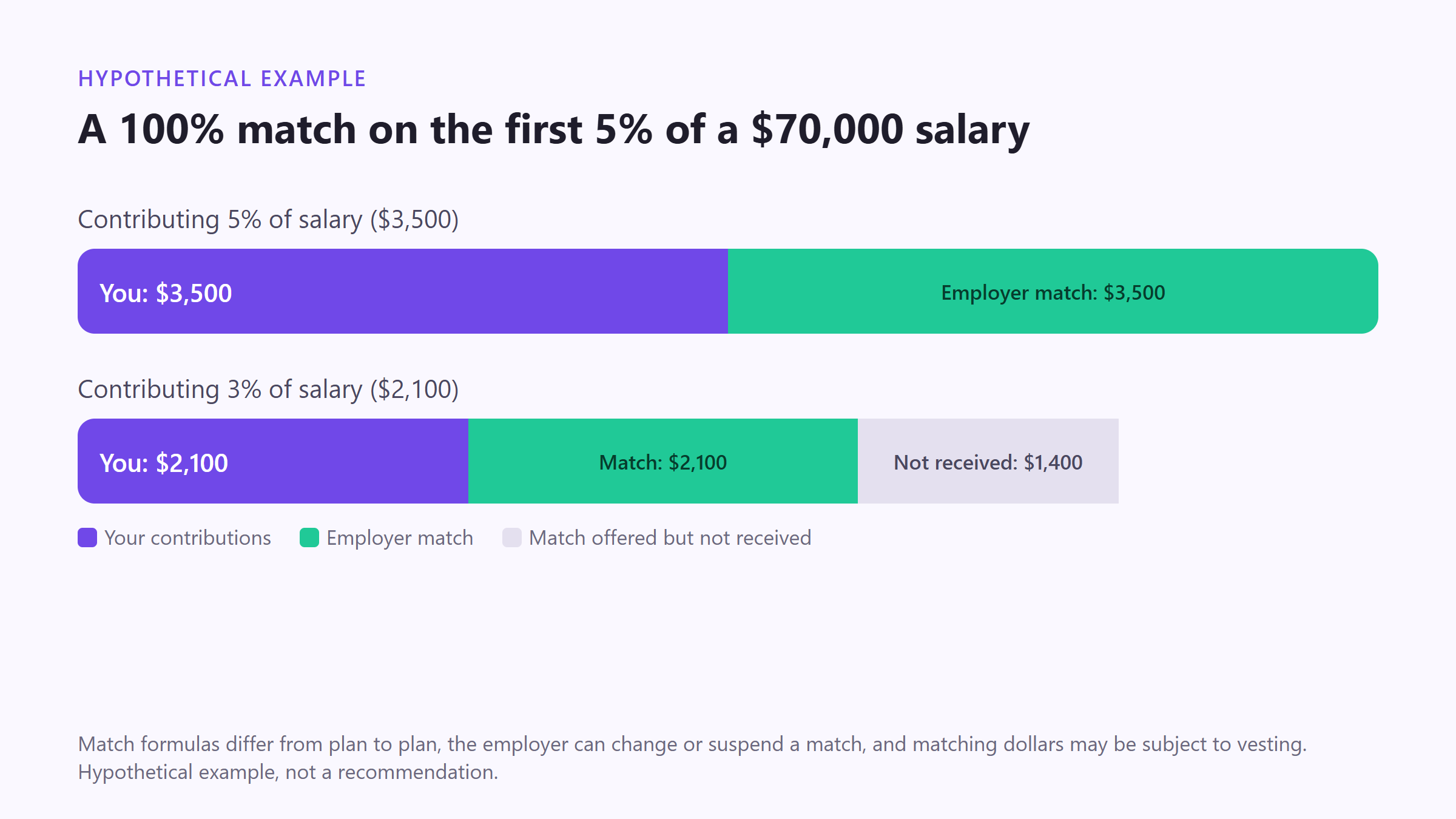
Consider a simple hypothetical example. Suppose you make $70,000 per year, and your company offers a 100% match on the first 5% of your salary.
Not contributing enough to receive the full match means giving up part of the benefit your employer offers. Match formulas differ from plan to plan, the employer can change or suspend a match, and matching dollars may be subject to vesting.
One detail to check: while your personal contributions are 100% yours from the second they leave your paycheck, your company's matching dollars may come with a waiting period called a vesting schedule.
Vesting is simply the company's timeline for earned ownership. If your plan uses a "3-year cliff vesting" rule, you must work at the company for three full years before you own any of their matching funds. Leave after two years, and you keep all your personal savings, but the employer match goes back to the company. If your company offers "immediate vesting," every matching dollar is yours to keep right away.
Two employers can both say they offer a 401(k) and still have very different plans. The plan's summary documents answer most of the practical questions, and a few of them are worth finding before you decide how much to contribute:
The government places strict annual caps on how much money you can deposit into a tax-advantaged 401(k) account.
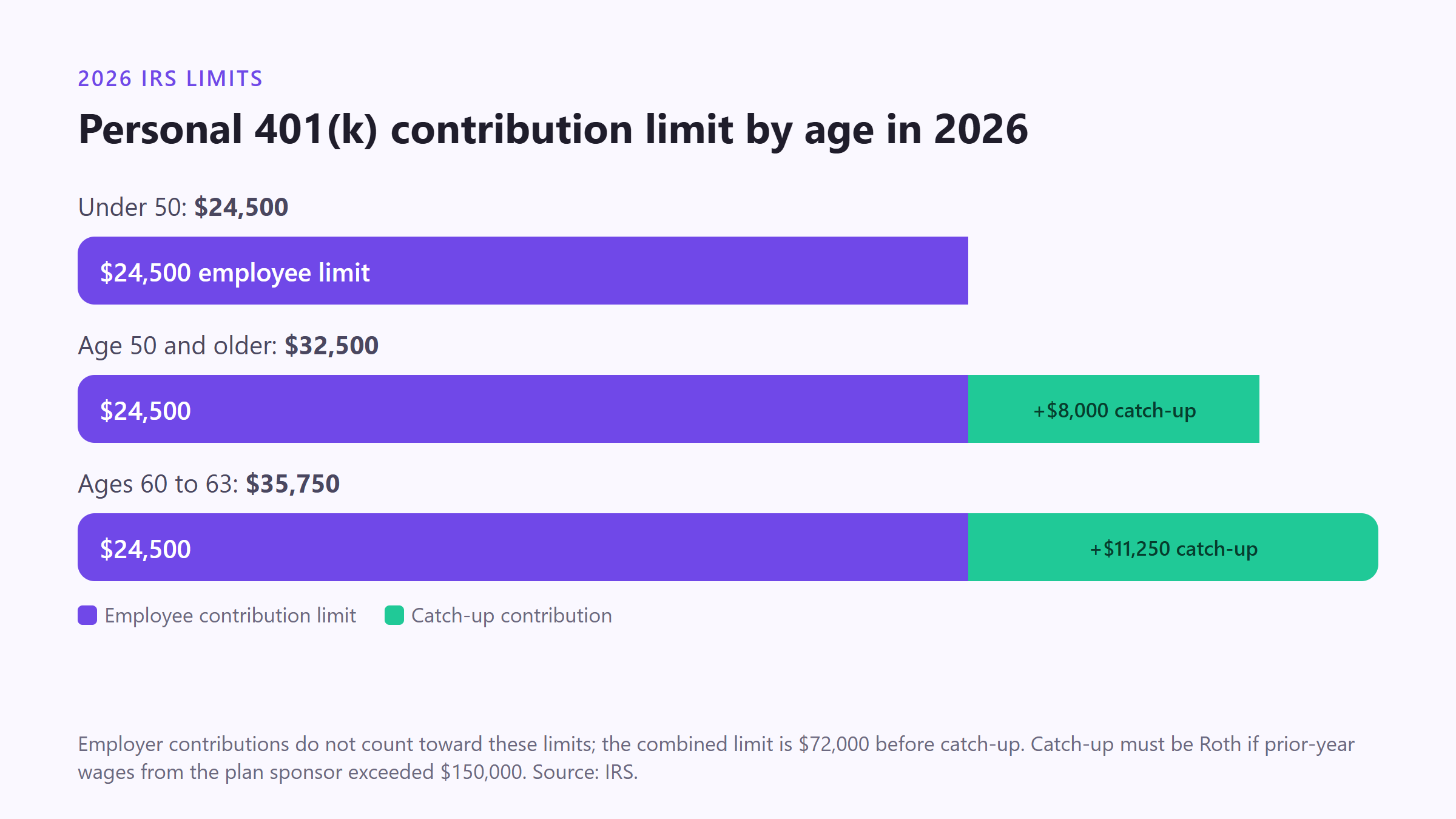
For 2026, the IRS sets the individual contribution limit at $24,500 per year. If you are age 50 or older, you get an extra "catch-up contribution" allowance of $8,000, pushing your personal limit to $32,500. If you turn 60, 61, 62, or 63 during the year, a higher catch-up of $11,250 applies instead, for a personal limit of $35,750. Starting in 2026, if your prior-year wages from the plan sponsor were above $150,000, your catch-up contributions must be made as Roth (after-tax) contributions. If your plan has no Roth option and the rule applies to you, you may not be able to make catch-up contributions to that plan.
Note that your employer’s matching contributions do not count toward your personal $24,500 cap. The IRS allows a combined total ceiling (your money plus employer contributions) of up to $72,000 per year, not counting catch-up contributions. With catch-up, the combined ceiling can reach $80,000 for age 50 and older, or $83,250 for ages 60 to 63.
Putting money into a 401(k) is only step one. Money sitting in cash inside your account may not grow. If you do not choose investments, many plans place your contributions in a default investment, often a target-date fund. You can usually change this and choose from the plan's investment menu.
Many company plans offer a curated list of mutual funds and low-cost index funds. If picking individual investments feels overwhelming, one option many plans offer is a Target-Date Fund (TDF). You select the fund matching the approximate year you plan to retire, for instance a "Target 2060 Fund." Fund managers adjust the asset allocation over time, starting with more stocks when you are young and gradually dialing back risk as you approach retirement. Target-date funds can lose value, and their fees and allocations differ from fund to fund.
Because the IRS gives tax advantages to retirement savings, it generally wants that money to stay put until retirement age. The key age to remember is 59½.
If you take money out of your 401(k) before age 59½, you generally owe income taxes plus a 10% additional tax, unless an exception applies. Hypothetical example: a $10,000 early cash-out could shrink to $6,500 or less after taxes.
The tax code includes a few built-in exceptions. Income tax can still apply:
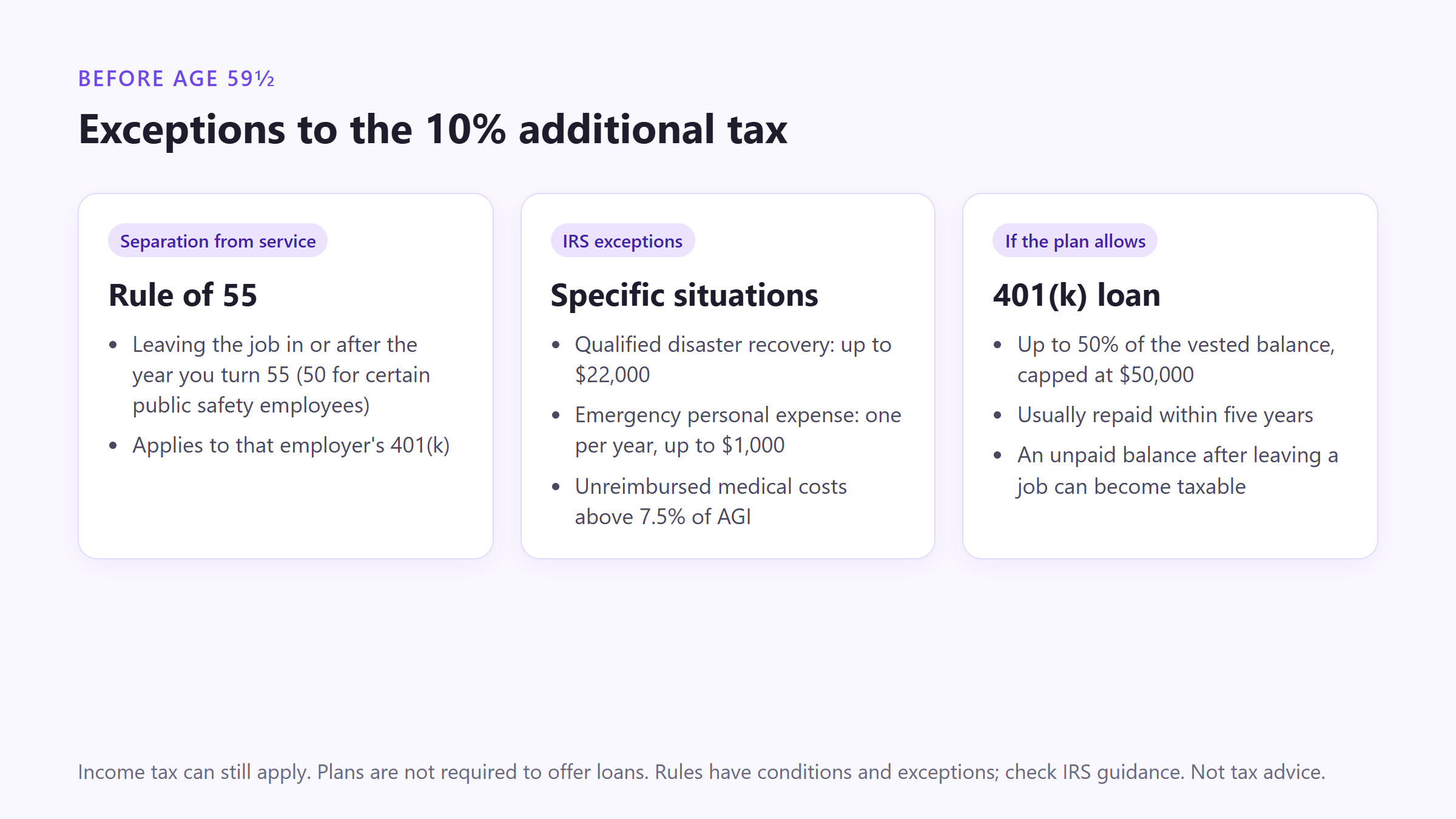
A hardship withdrawal is for an immediate and heavy financial need, such as medical care, costs tied to buying a principal residence, up to 12 months of tuition, preventing eviction or foreclosure, funeral expenses, or certain home repairs. It is generally taxed as income and may also face the 10% additional tax, because hardship is not itself an exception. A hardship withdrawal also cannot be repaid to the plan or rolled over. Plans are not required to offer hardship withdrawals.
You cannot keep cash inside a pre-tax 401(k) indefinitely. RMDs generally start at age 73 if you were born from 1951 through 1959, and at age 75 if you were born in 1960 or later (as reflected in IRS proposed regulations issued in 2024). If you are still working for the plan's sponsor and are not a 5% owner, your plan may let you delay RMDs from that plan until you retire. Designated Roth 401(k) accounts have no lifetime RMDs. For pre-tax accounts, RMDs make sure taxes are eventually paid on the savings.
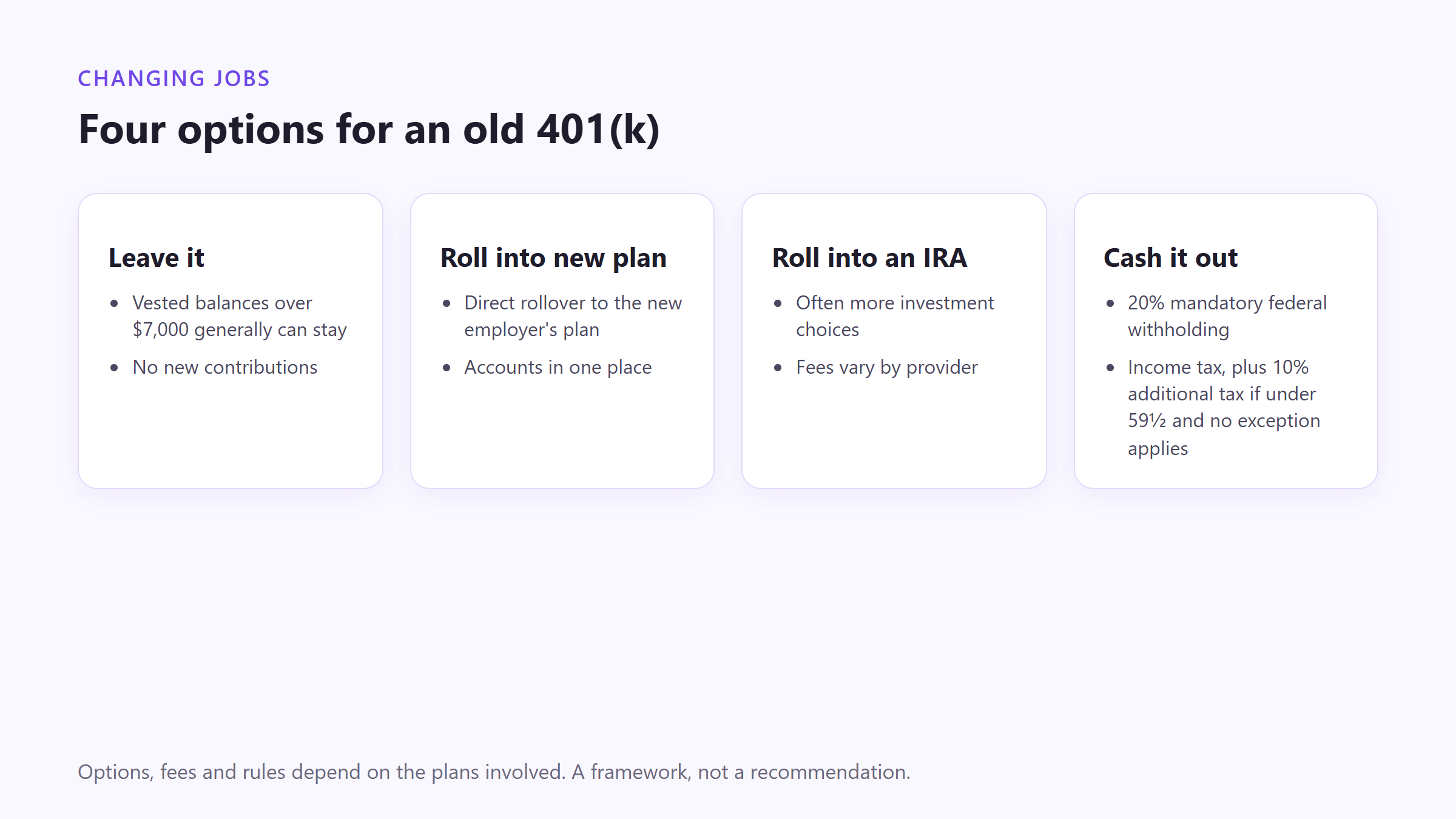
Changing employers is extremely common, but your old 401(k) doesn't disappear when you leave a job. You generally have four distinct paths forward:
The core mechanics are almost identical. Private, for-profit businesses use 401(k) plans. Non-profit organizations, hospitals, and public schools use 403(b) accounts. State and local government entities use 457(b) plans. Distributions from a governmental 457(b) are generally not subject to the 10% additional tax, even before 59½, though income tax still applies. The exception is amounts rolled in from other types of plans.
Yes, if you have no employees other than a spouse. A Solo 401(k) is designed for freelancers, 1099 contractors, and small business owners. You contribute as both the employee (up to $24,500 for 2026) and the employer (up to 25% of compensation, with a reduced rate for self-employed owners; see IRS Publication 560 for the calculation), up to the overall $72,000 limit, plus catch-up contributions if you are eligible.
In general, yes. A 401(k) is a workplace benefit, while an IRA is an account you open independently. One commonly discussed order is contributing enough to your 401(k) to receive the full employer match, then funding an IRA, then returning to fill the rest of your 401(k). That is a framework, not a recommendation. Roth IRA eligibility and traditional IRA deductibility depend on your income and whether you are covered by a workplace plan.
Disclaimer: This material is intended for educational purposes only and does not constitute tax, legal, or investment advice, and it does not consider your individual circumstances. Snowball Analytics is a portfolio-tracking tool. It is not a registered investment adviser, broker-dealer, or tax preparer. Figures reflect federal limits for tax year 2026, checked on 2026-10-22. IRS rules and contribution limits change periodically, so verify at IRS.gov. Consult a qualified financial advisor or tax professional regarding your personal situation.