


Building wealth for retirement doesn't require a corporate job or a complex financial degree. While employer plans like 401(k)s get most of the spotlight, many investors save for retirement using an Individual Retirement Account (IRA). An IRA is simply a personal, tax-advantaged investment account that you open on your own at a financial institution such as a brokerage firm. Because the IRS gives tax advantages to retirement savings, your investments can grow inside an IRA without annual taxes on dividends and gains, unlike in a regular taxable account. Investments can lose value.
The Short Version: IRA Fundamentals
| Item | 2026 rule | Source |
|---|---|---|
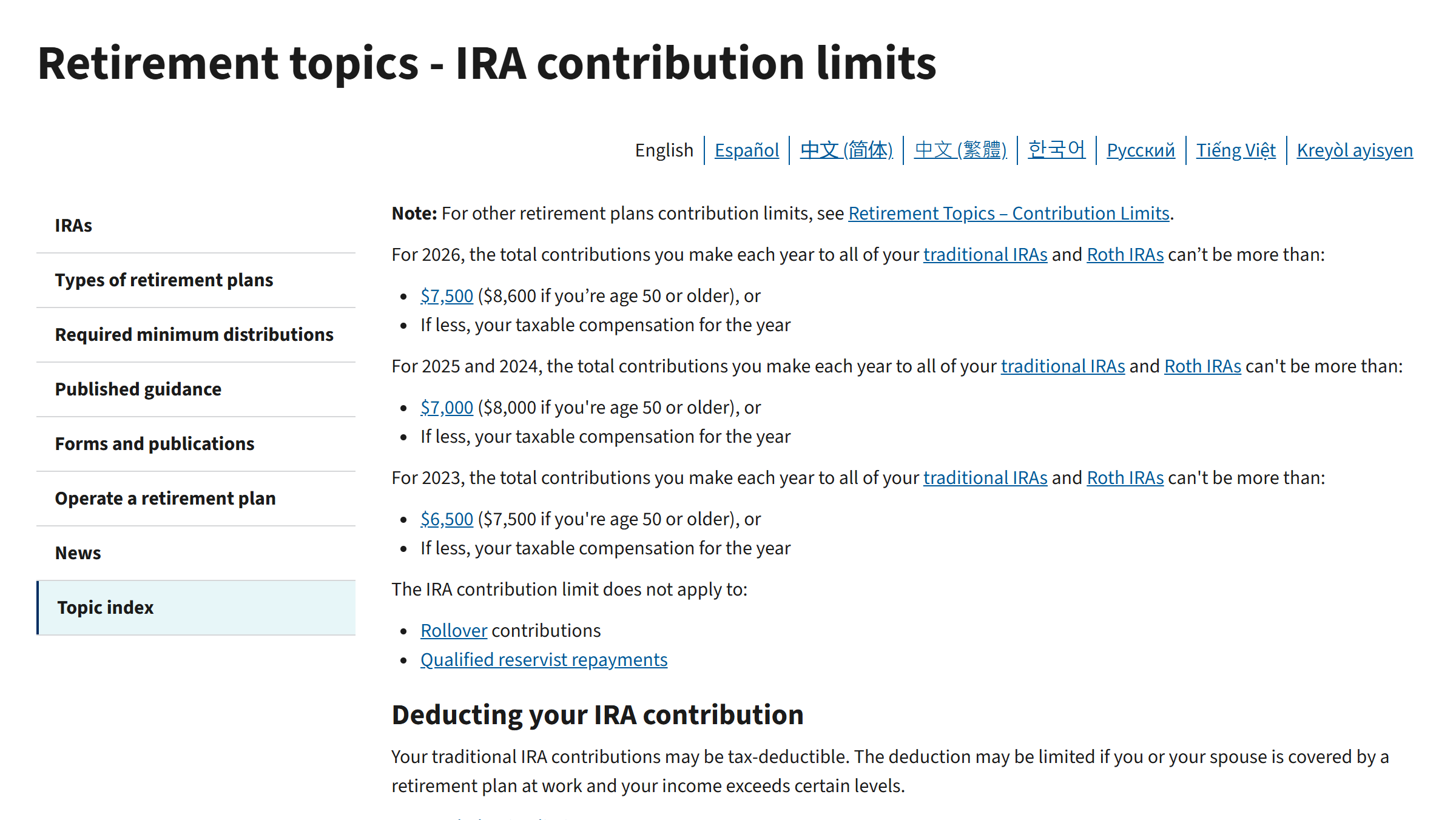
| Contribution limit | $7,500, or $8,600 if you are 50 or older, or your taxable compensation if that is less. One limit applies to all your traditional and Roth IRAs combined. | IRS, IRA contribution limits; IR-2025-111 |
| Contribution deadline | The due date of your return for that year, not including extensions (generally April 15, 2027 for 2026) | IRS Publication 590-A |
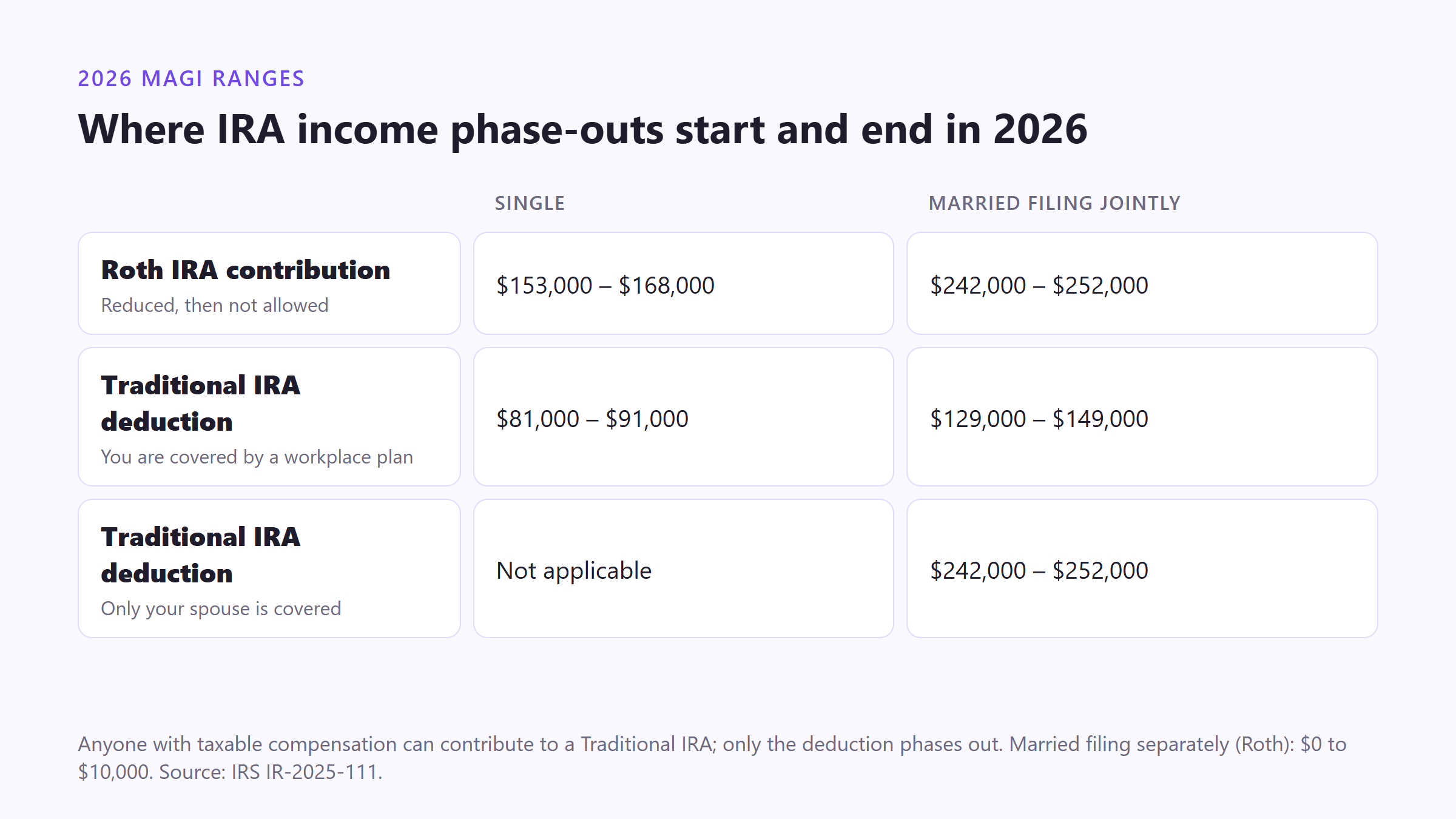
| Roth IRA income phase-out | Single or head of household: $153,000 to $168,000. Married filing jointly: $242,000 to $252,000. Married filing separately: $0 to $10,000. | IR-2025-111 |
| Traditional IRA deduction phase-out (covered by a workplace plan) | Single: $81,000 to $91,000. Married filing jointly: $129,000 to $149,000. Not covered but spouse is: $242,000 to $252,000. | IR-2025-111 |
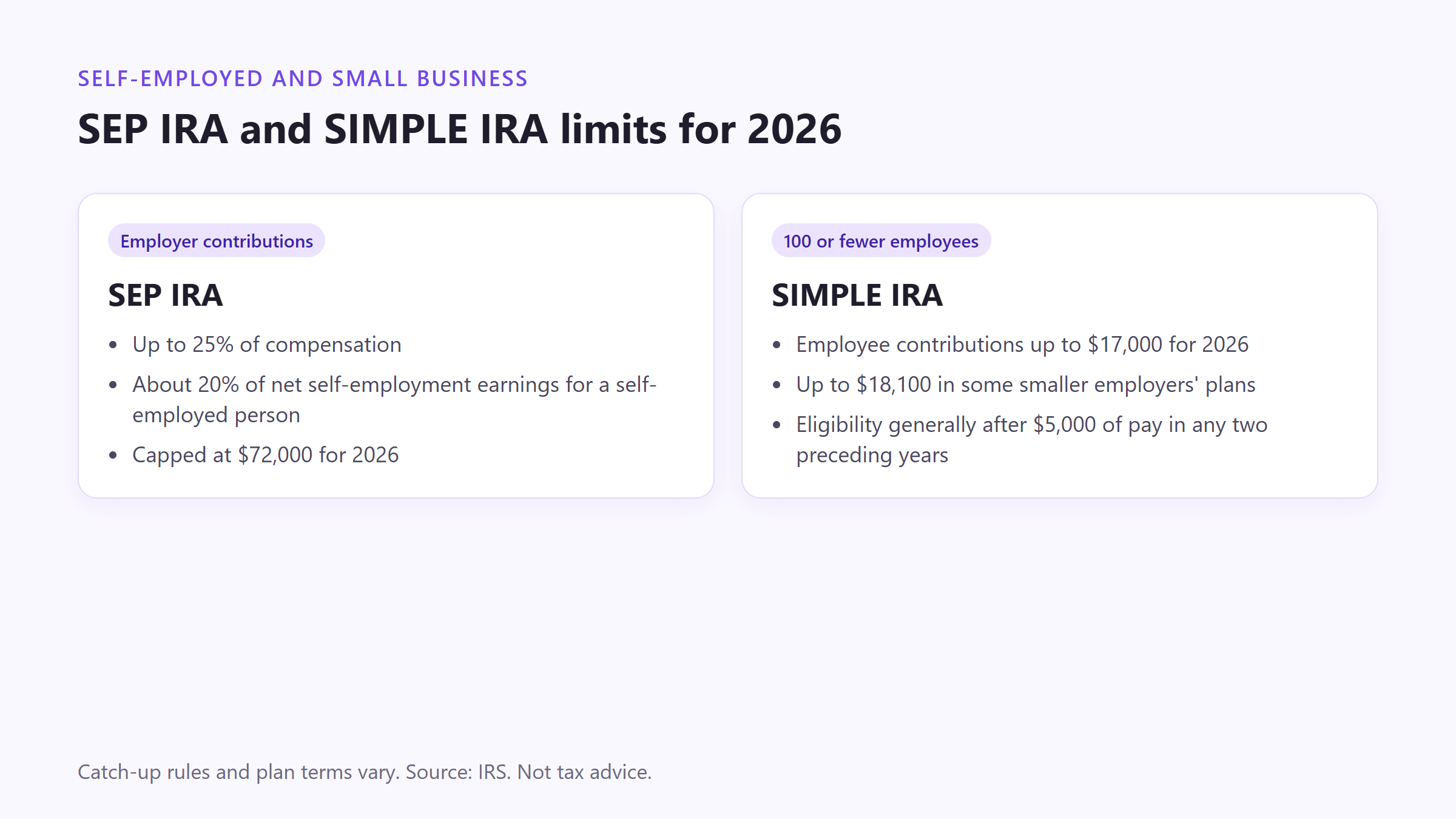
| SEP IRA | The lesser of 25% of compensation or $72,000 | IRS, SEP contribution limits |
| SIMPLE IRA | $17,000, plus a $4,000 catch-up at 50 and older ($5,250 at ages 60 to 63) | IRS, SIMPLE IRA plan |
| Excess contributions | 6% tax each year the excess stays in the account | IRS, IRA contribution limits |
To fund an IRA, you (or your spouse, on a joint return) need taxable compensation, which is money earned from working a job, running a business, or freelancing. Your contribution can't exceed your taxable compensation for the year. Rental income, dividends, and interest don't count as compensation.
The main distinction between an IRA and a workplace 401(k) boils down to ownership and flexibility. A 401(k) is set up by your employer, who selects the menu of investments you pick from. An IRA belongs entirely to you. You choose where to open it, you control the account independently of your employer, and you typically have a wider range of investments to choose from.
| Feature | IRA (Individual Retirement Account) | 401(k) Workplace Plan |
|---|---|---|
| Account Ownership | Individually opened by you at a financial institution. | Sponsored and managed by your employer. |
| Investment Options | A wide range (stocks, ETFs, bonds, index funds), depending on the provider. | A menu of employer-chosen investments. |
| Employer Match | No matching funds. You supply 100% of deposits. | Many companies match part of your contributions. |
The compensation rule has a useful exception for married couples. If you file a joint return and your own taxable compensation is less than your spouse's, or you have none, you can still contribute to your own IRA based on the couple's combined compensation.
Your limit is the smaller of the annual IRA limit ($7,500 for 2026, or $8,600 if you are 50 or older) or the couple's combined taxable compensation minus the amount your spouse contributes to their own IRAs for the year. Hypothetical example: if one spouse earns $90,000 and the other has no taxable compensation, both spouses could each contribute up to the annual limit for 2026, as long as the combined compensation covers it. Roth eligibility and the traditional IRA deduction are still tested against the couple's income and workplace-plan coverage.
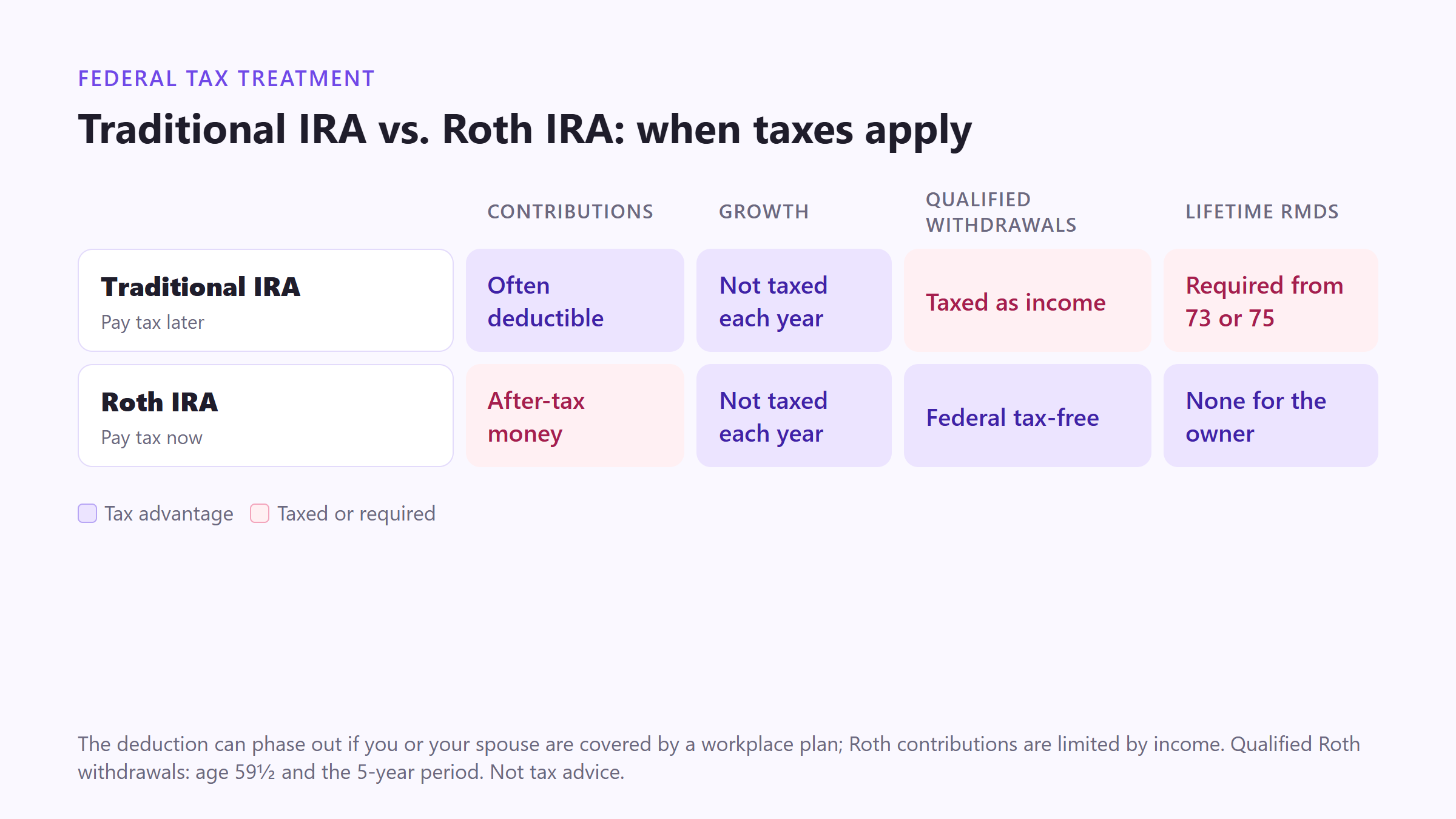
Selecting between a Traditional IRA and a Roth IRA is one of the main decisions you will make when opening an account. The underlying investments inside both accounts can be identical. The difference comes down to how the IRS taxes your money.
| Key Comparison | Traditional IRA | Roth IRA |
|---|---|---|
| Tax Deduction Today | Often: Contributions may reduce your taxable income for the current year, unless you (or your spouse) are covered by a workplace plan and your income is above the limits. | No: You contribute after-tax income. |
| Taxes on Retirement Withdrawals | Withdrawals are taxed as regular income when you retire, except for any nondeductible contributions you already paid tax on. | Tax-free if qualified: Qualified withdrawals (age 59½ or older, after the 5-year period that begins with the first tax year you contributed) are free of federal income tax. Distributions because of disability, after death, or for a first-home purchase (up to $10,000 lifetime) also qualify once the 5-year period is met. |
| Income Limits | Anyone with taxable compensation can contribute, but the deduction can phase out at higher incomes if you or your spouse are covered by a workplace plan. | Direct contributions are reduced or blocked if your income exceeds IRS MAGI limits. |
| Early Access to Deposits | Early withdrawals of the taxable part are taxed as income and generally face a 10% additional tax. | Contributions only: You can withdraw your original contributions anytime without tax or penalty. Early withdrawals of earnings are generally taxed and may face the 10% additional tax. |
| Required Minimum Distributions | Yes: Mandatory annual withdrawals start at age 73 if you were born from 1951 through 1959, and at age 75 if you were born in 1960 or later. | No: Original owners are not required to take distributions during their lifetime. |
If you expect your income to be significantly lower in retirement than it is today, a Traditional IRA may be worth considering. If your contribution is deductible, it can lower your current tax bill, leaving you more cash to invest or spend today.
Conversely, if you are early in your career, sitting in a lower tax bracket today, or anticipate higher tax rates in the future, a Roth IRA may be worth considering. You pay tax on the contribution today, and qualified withdrawals later are free of federal income tax. Future tax rates are uncertain, and many people hold both types.
If you work for yourself, standard personal IRA deposit caps might feel restrictive. The tax code provides employer-sponsored IRA types designed for entrepreneurs and small business owners, with higher limits:
To keep high earners from sheltering unlimited wealth, the IRS enforces strict annual deposit caps and income phase-out rules on personal IRAs.
For 2026, the baseline individual contribution cap across all your personal IRAs combined is $7,500. If you are age 50 or older, the IRS allows an additional $1,100 "catch-up contribution," bringing your annual maximum to $8,600. Your contribution also can't exceed your taxable compensation if that is less. Contributions for 2026 can be made until the due date of your 2026 return, generally April 15, 2027 (extensions do not apply to contributions).
Your eligibility to claim IRA tax perks depends on your Modified Adjusted Gross Income (MAGI):
For Roth IRAs, your direct contribution limit is reduced as your MAGI moves through a phase-out range, and you are barred from making direct contributions above the top of it (for 2026, single filers phase out between $153,000 and $168,000; married couples filing jointly phase out between $242,000 and $252,000).
For Traditional IRAs, anyone with taxable compensation can make a contribution, but if you or your spouse are covered by a plan at work, your ability to deduct those contributions on your tax return phases out at higher income levels. For 2026, if you are covered by a workplace plan, the deduction phases out between $81,000 and $91,000 for single filers and between $129,000 and $149,000 for married couples filing jointly. If you are not covered but your spouse is, the range is $242,000 to $252,000.
IRA rules are simple to describe but easy to trip over in practice. These are the situations that most often lead to an excess contribution or a missed opportunity:
Because IRAs exist to support long-term retirement saving, the tax code imposes restrictions on taking money out early. The baseline milestone age for penalty-free access is 59½.
If you take money out of a Traditional IRA before age 59½, the taxable part (generally all of it, unless you made nondeductible contributions) is taxed as income and generally faces a 10% additional tax. From a Roth IRA, your contributions come out first without tax or penalty, while earnings withdrawn early are generally taxed and may face the 10% additional tax. The IRS permits exceptions to the 10% additional tax in a few specific situations, such as paying for qualified higher education costs, covering major unreimbursed medical expenses, or taking up to $10,000 for a first-time home purchase.
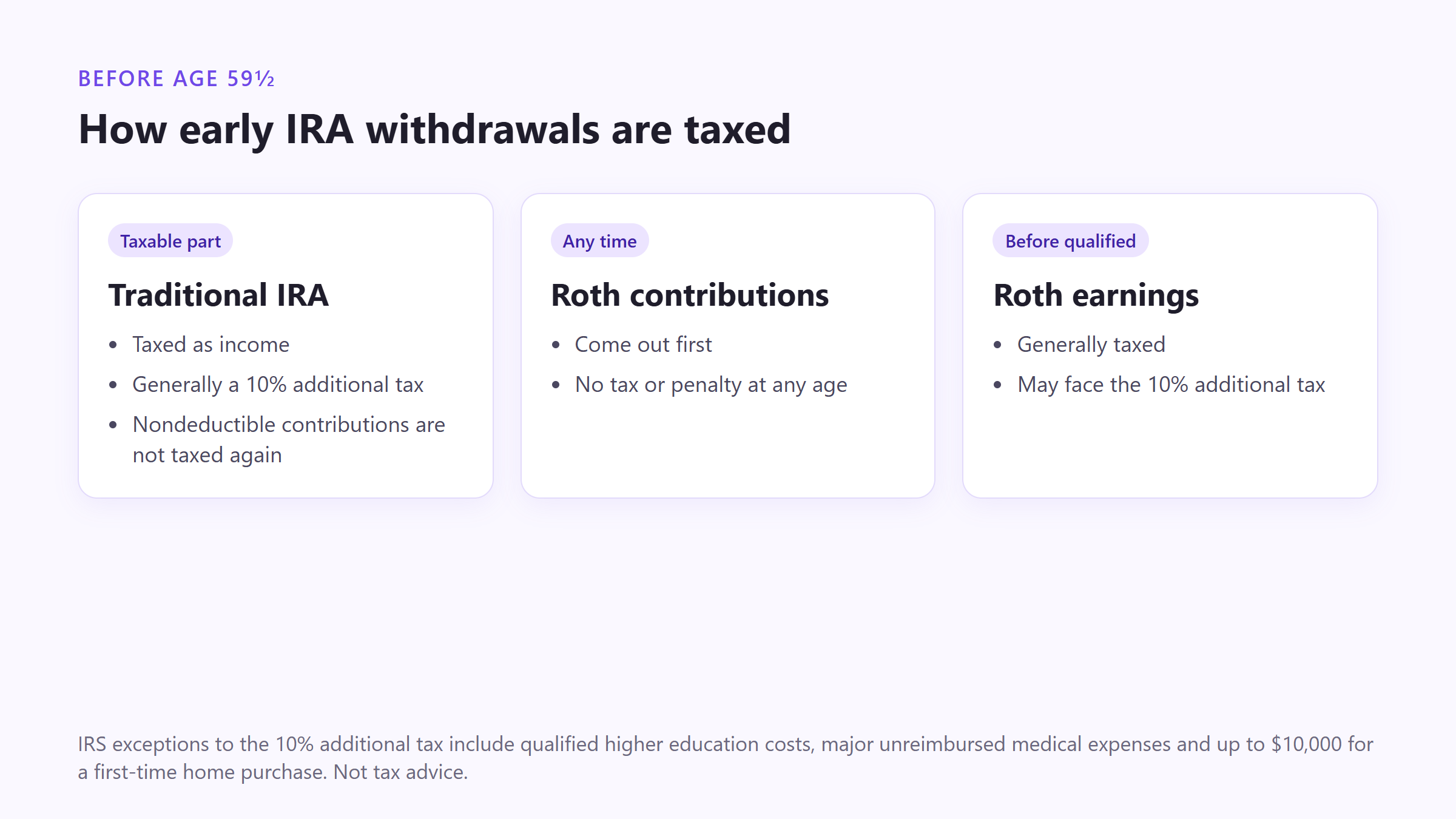
One feature that sets the Roth IRA apart from many other retirement accounts: your original contributions can be withdrawn at any time. Because you already paid income tax on the dollars you deposited, withdrawing your original contribution amount is not taxed and not penalized, at any age and for any reason. Earnings withdrawn before the account meets the qualified distribution rules can be taxed and may face the 10% additional tax.
Pre-tax accounts cannot stay tax-deferred forever. Traditional IRAs require you to begin taking Required Minimum Distributions (RMDs) each year, starting at age 73 if you were born from 1951 through 1959, and at age 75 if you were born in 1960 or later (as reflected in IRS proposed regulations issued in 2024). The first RMD is due by April 1 of the year after you reach your starting age. The IRS calculates the minimum amount based on your age and account balance so that taxes are eventually paid on pre-tax savings. Original owners of a Roth IRA are not required to take distributions during their lifetime.
Setting up an IRA is a straightforward process that can usually be done online:
Disclaimer: This material is intended for educational purposes only and does not constitute tax, legal, or investment advice, and it does not consider your individual circumstances. Snowball Analytics is a portfolio-tracking tool. It is not a registered investment adviser, broker-dealer, or tax preparer. Figures reflect federal limits for tax year 2026, checked on 2026-10-22. IRS rules, tax brackets, and contribution limits change periodically, so verify at IRS.gov. Consult a qualified financial advisor or tax professional regarding your personal situation.