



Time moves fast when you are raising a child, and the clock on future education costs keeps ticking. Between rising tuition rates and everyday household expenses, funding a college education can feel overwhelming. The tax code offers a tool built for families saving for education: the 529 plan. An officially recognized tax-advantaged account, a 529 plan lets you invest money for your child's or grandchild's future while the investment growth compounds without annual taxes.
Key Takeaways: 529 Plan Essentials
| Item | 2026 rule | Source |
|---|---|---|
| K-12 qualified withdrawals | Up to $20,000 per beneficiary per year (was $10,000) | 26 U.S.C. §529 |
| Student loan repayment | Up to $10,000 lifetime per person (beneficiary and each sibling) | IRS Publication 970 |
| 529 to Roth IRA rollover | $35,000 lifetime, within the annual Roth IRA limit ($7,500 for 2026) | 26 U.S.C. §529(c)(3)(E); IRS Topic 313; IRS IR-2025-111 |
| FAFSA assessment of a parent-owned 529 | Parent assets are converted at a 12% rate, then feed into the parent contribution, where rates run up to 47% | FSA Handbook 2026-27, Student Aid Index |
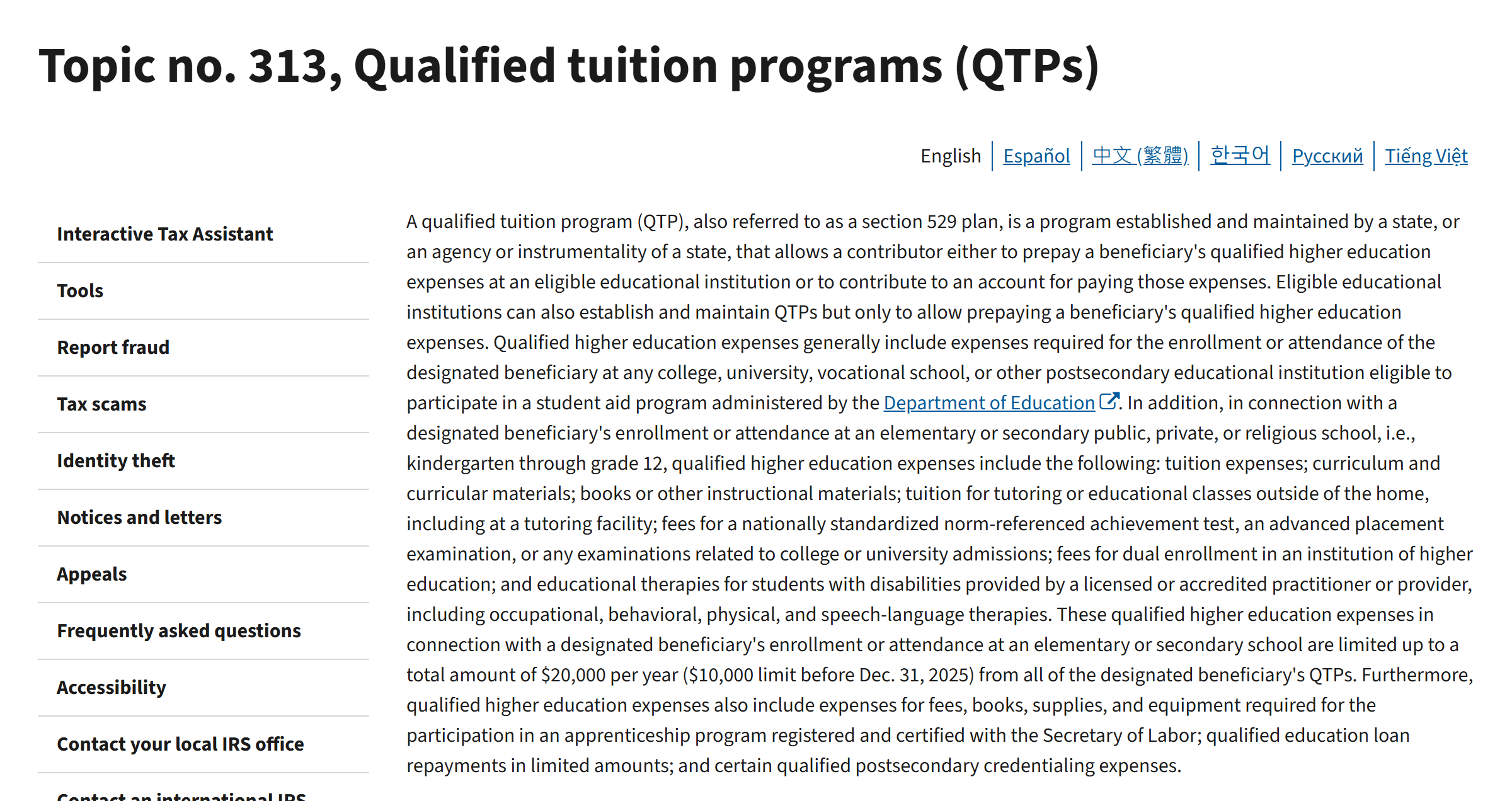
Named after Section 529 of the Internal Revenue Code, a 529 plan is a state-sponsored investment vehicle created to help families save for education costs. You deposit after-tax dollars from your bank account and select an investment portfolio. Most plans offer age-based portfolios that start aggressive with stocks when your child is a toddler and gradually shift toward conservative bonds as freshman year approaches. Investments can lose value.
The key feature is how the IRS treats your growth. In a standard brokerage account, you pay annual income taxes on dividends and capital gains. Inside a 529 plan, your investments compound without those annual taxes. When your student heads off to school, withdrawals used for qualified education expenses are free of federal income tax.
When shopping for a plan, you will encounter two main options. The College Savings Plan is the more common type and offers more flexibility for an unpredictable future.
| Feature | 529 College Savings Plan | 529 Prepaid Tuition Plan |
|---|---|---|
| How It Works | You invest in market portfolios (mutual funds). Balance grows with market performance. | You lock in current tuition rates by purchasing future college credits today. |
| School Choice | Nationwide flexibility: Valid at almost any eligible public, private, or trade school. | Restricted: Primarily designed for in-state public universities where you reside. |
| Covered Costs | Tuition, fees, room and board, books, computers, and specialized equipment. | Usually covers tuition and mandatory fees only (excludes housing and food). |
You are not limited to the plan from your own state, and plans differ in ways that affect cost and tax treatment. These are the questions that usually separate one plan from another:
Understanding the tax incentives behind 529 plans helps you see what the account does and does not do over a long timeline.
At the federal level, your earnings are not taxed while they stay in the account, and qualified withdrawals are free of federal income tax. Contributions are not deductible on your federal return. Over many years, tax-free compounding can add to the account's value compared with a taxable account, depending on how much you contribute and how the investments perform.
At the state level, more than 30 states plus Washington D.C. offer a state income tax deduction or credit for residents contributing to a 529 plan (the exact count depends on whether credits are included; see the state-by-state list). Depending on your state, this can lower your state taxable income or your state tax bill. Some states require you to use their own plan, and some recapture the deduction if the money is later withdrawn for a non-qualified use. Check your state's current rules.
Gift tax and large contributions. A contribution to a 529 is a gift to the beneficiary. For 2026, the federal annual gift tax exclusion is $19,000 per recipient. A special election lets a contributor treat a larger lump sum as if it were given evenly over five years, up to five times the annual exclusion ($95,000 for 2026). The election is made on Form 709. Contributions above that amount for one person count as gifts in the year they are made. Many people ask a tax professional before using this election.

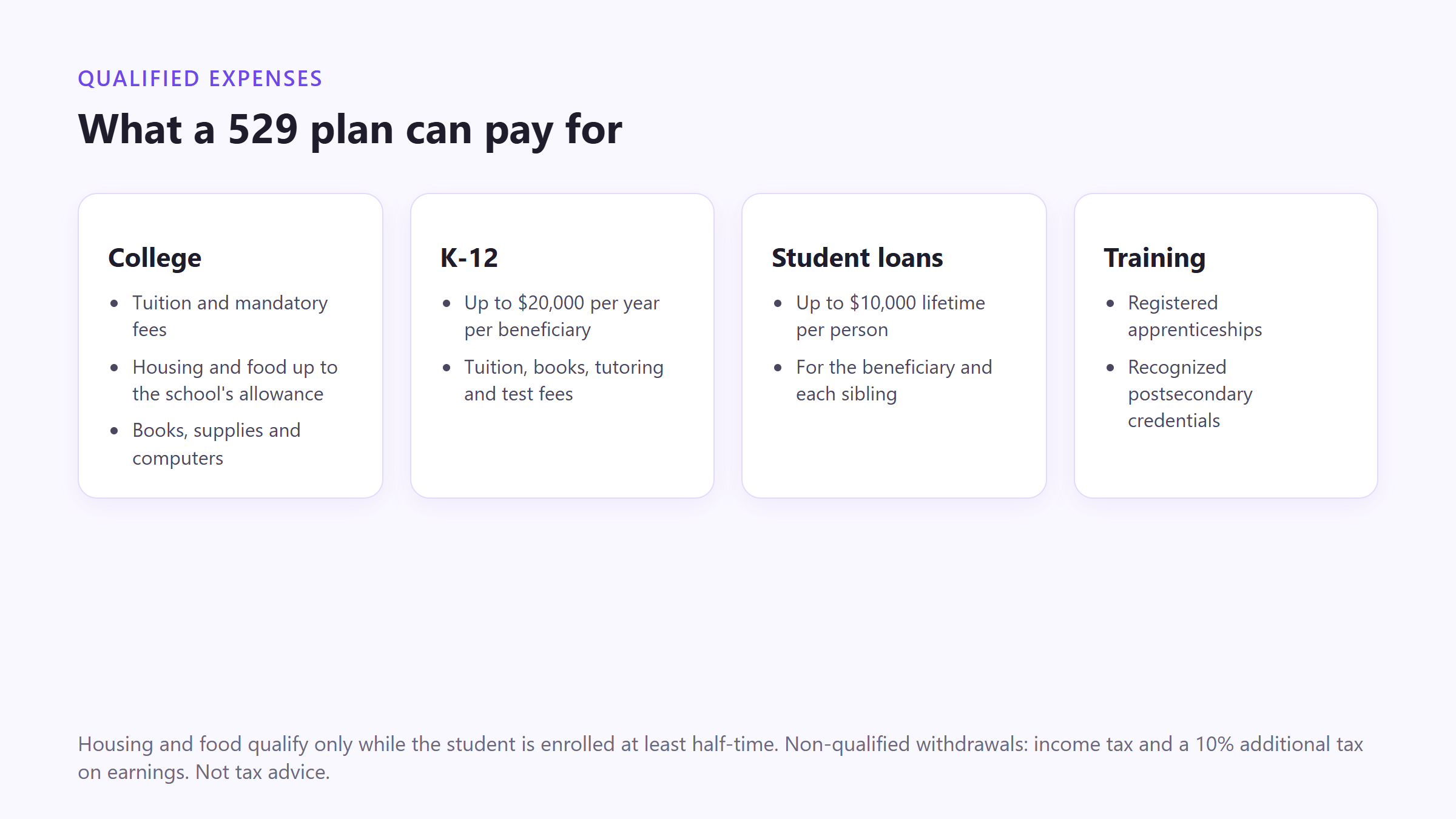
A common misconception among parents is that 529 funds can only be spent on traditional four-year college tuition. In reality, federal law defines "Qualified Higher Education Expenses" broadly to reflect modern student life.
Checklist of IRS-Approved 529 Expenses:
The tax-free treatment depends on how a withdrawal lines up with an actual expense, so keeping records matters. A few points that commonly cause problems:
Recent federal legislation (Pub. L. 119-21) widened what a 529 can pay for outside of college:
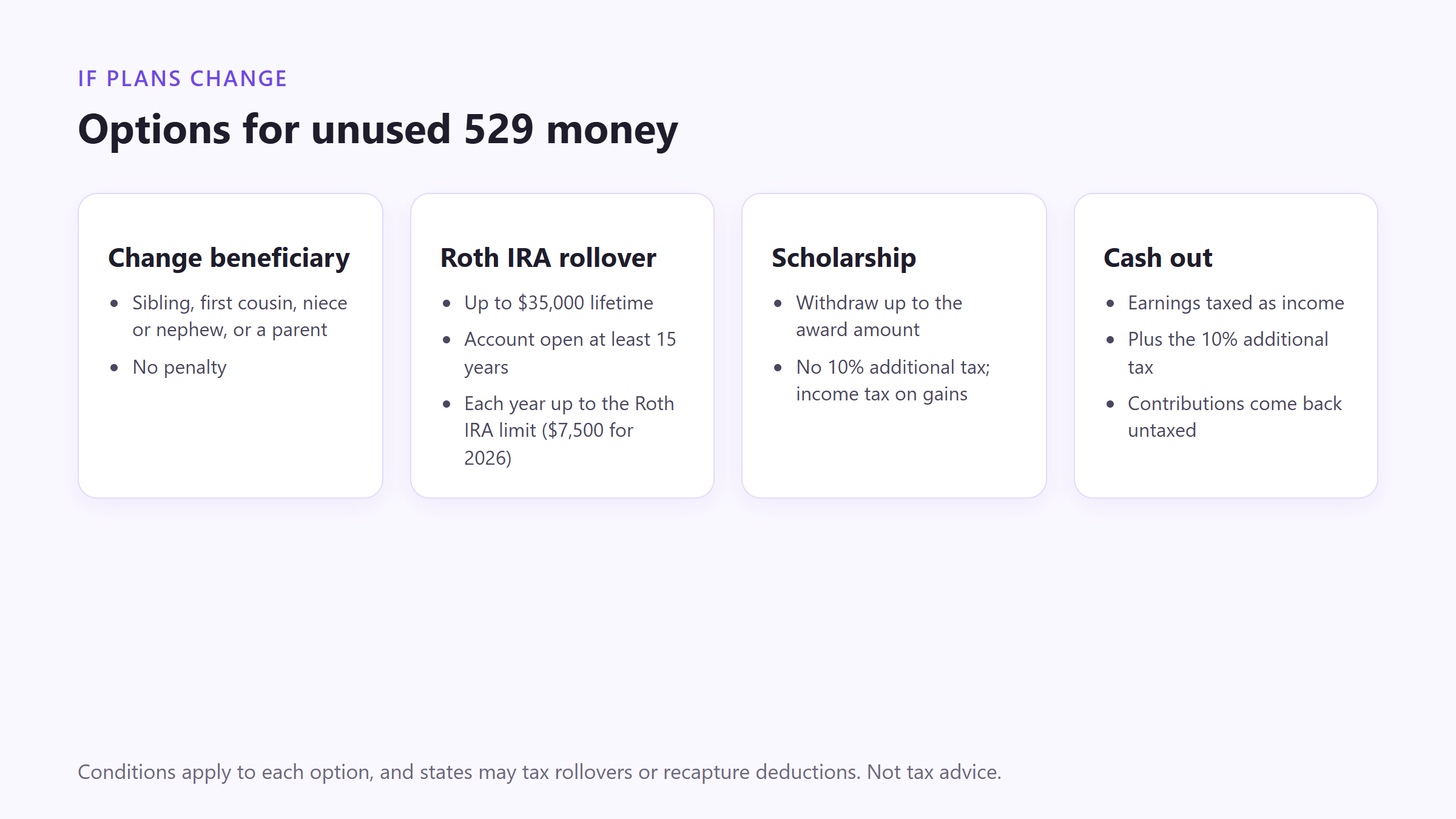
A common worry among parents is overfunding an account or locking away money if a child chooses a different life path. 529 plans provide several flexible options.
Because the owner keeps control of the account, the money is not tied to one beneficiary. If your eldest child skips college or receives a full scholarship, you can change the beneficiary to a sibling, a first cousin, a niece or nephew, or a parent (including you, if you are the beneficiary's parent), with no penalty. Changing to someone in a younger generation can have gift or generation-skipping tax implications, so it may be worth reviewing with a tax professional first.
Under the SECURE 2.0 Act, unused education funds can be rolled into a Roth IRA in the beneficiary's name, up to $35,000 over the beneficiary's lifetime. Several conditions apply:
If your child earns a merit or athletic scholarship, you can withdraw an amount equal to the scholarship award without paying the 10% additional tax. You will still owe ordinary income tax on the portion of the withdrawal representing investment gains.
If you need to pull money out for non-educational reasons, you can cash out the account at any time. Only the investment growth portion is subject to income tax and the 10% additional tax. The contribution portion comes back without either. Each withdrawal is treated as a proportional mix of contributions and earnings, so you cannot choose to take out only your contributions. Your state may also recapture deductions you claimed earlier.
Financial aid rules affect how much a 529 can help, so they are worth understanding before you save. Here is how a 529 plan affects your child's aid eligibility and overall savings picture.
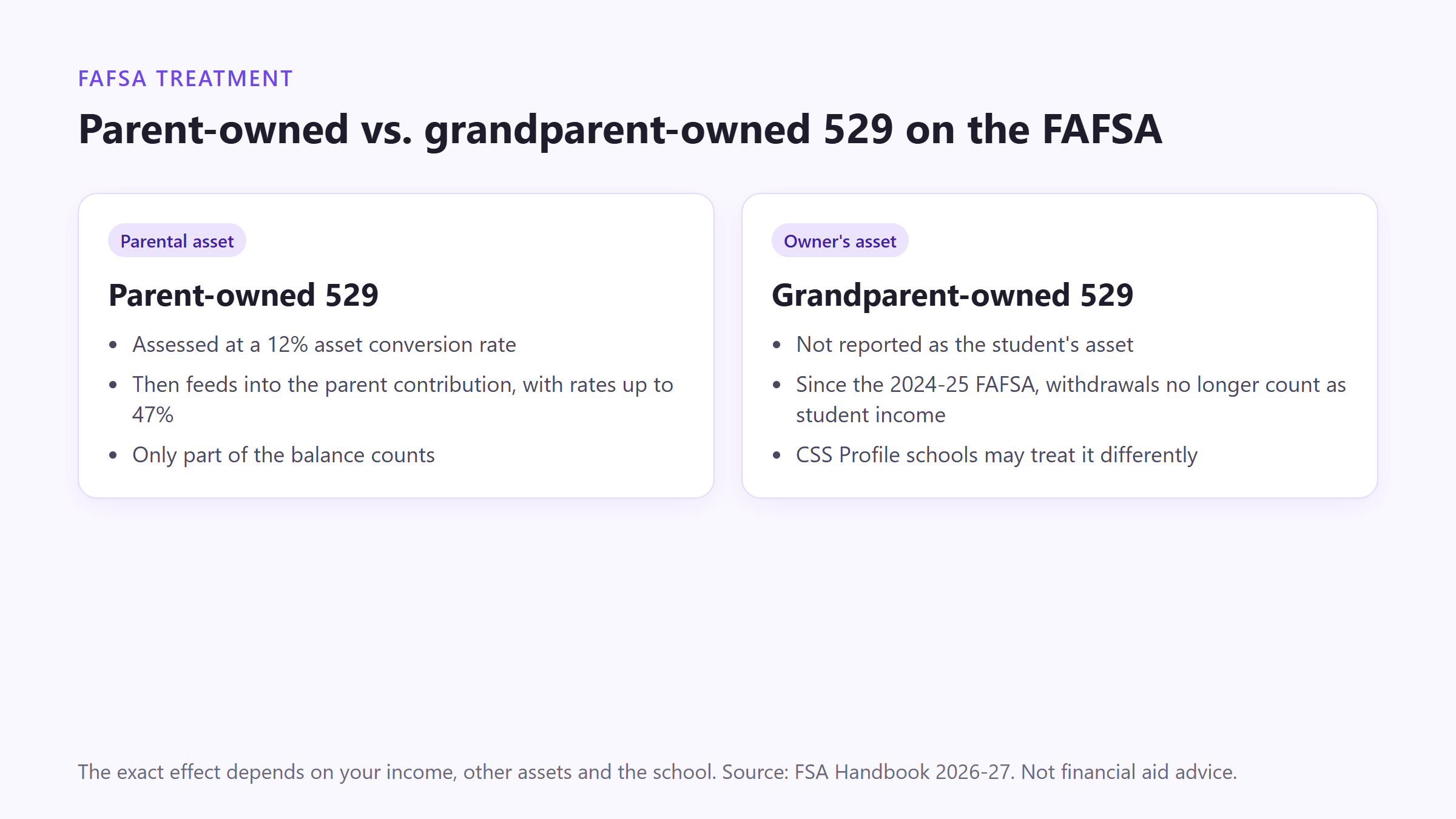
Parents often worry that saving in a 529 plan will hurt their chances for financial aid. FAFSA treats parent-owned 529 plans as parental assets, which are assessed using a 12% asset conversion rate. That amount then feeds into the parent contribution, where the rates run up to 47%. Only a portion of the balance counts against aid eligibility, and the exact effect depends on your income, your other assets, and the school.
A grandparent-owned 529 plan is treated differently. A 529 is reported as an asset of its owner, so when a grandparent owns the account and the student is only the beneficiary, it is not reported as the student's asset. Since the 2024-25 FAFSA, the form also no longer counts money received by or paid on behalf of the student as untaxed income, so a withdrawal from a grandparent-owned account does not reduce aid under the FAFSA formula. Colleges that use the CSS Profile may still ask about these accounts and treat them differently.
Pros:
Cons:
Disclaimer: State 529 plan tax deductions and benefits vary by jurisdiction. This material is intended for educational purposes only and does not constitute tax, legal, or financial advice, and it does not consider your individual circumstances. Snowball Analytics is a portfolio-tracking tool. It is not a registered investment adviser, broker-dealer, or tax preparer. Figures reflect federal limits for tax year 2026, checked on 2026-10-22. Rules change, so verify at IRS.gov. Consult a qualified tax professional regarding your personal situation.