

 Stock Analysis
 General
 Library
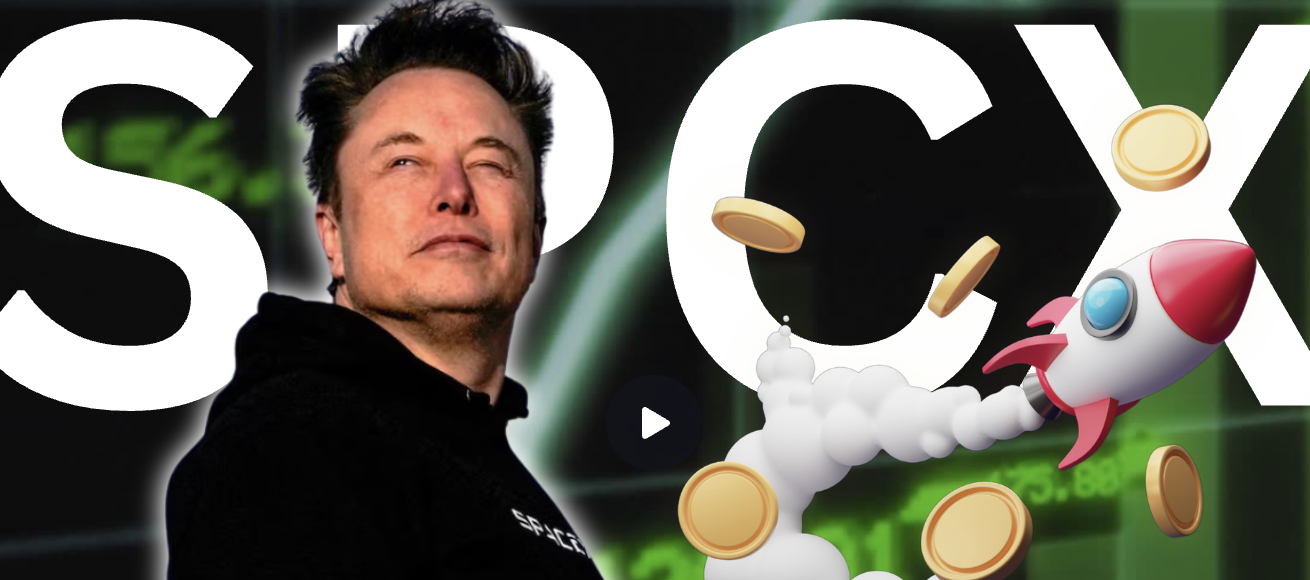
The Most Anticipated IPO on Earth — And Why the Biggest Opportunity May Not Be on Day One
There are market events that dominate financial news for a week.
Then there are events that reshape conversations for years.
A potential public debut of $SPCX falls squarely into the second category.
Over the last decade, SpaceX evolved from an ambitious aerospace startup into one of the most influential private companies in the world. What began as a rocket business has expanded into satellite communications, global internet infrastructure, defense contracts, launch services, and increasingly, artificial intelligence-related computing capabilities.
That growth has led to an eye-catching valuation estimate approaching $1.75 trillion, a figure that would immediately place SpaceX among the most valuable companies ever traded publicly.
For perspective, a valuation of that size would exceed the combined market values of several iconic consumer brands that have shaped everyday life for decades, including:
The Coca-Cola Company
McDonald's
The Walt Disney Company
Nike
Starbucks
The scale is difficult to comprehend. Yet valuation alone is not what makes this story important.
The real story is what happens when a company this large enters public markets.
Many investors automatically assume that index funds, retirement accounts, and ETFs will immediately begin buying shares, creating an unstoppable wave of demand.
The reality is considerably more nuanced.
Understanding that distinction may save investors from making emotional decisions during one of the most anticipated market events in recent memory.
The Hidden Battle Happening Inside Index Funds
One of the biggest misconceptions surrounding a large IPO is the belief that passive funds instantly become forced buyers.
That assumption is only partially true.
Many investors own broad market funds through retirement plans and brokerage accounts without ever thinking about the underlying mechanics. When a company enters a major index, those funds must purchase shares regardless of valuation.
However, not every index follows the same rules.
The most widely followed benchmark in the United States, the S&P 500, traditionally requires companies to satisfy profitability requirements before inclusion. According to the discussion surrounding SpaceX, this requirement could delay automatic purchases from S&P-linked funds.
That matters because billions of dollars that investors expected to flow automatically into SpaceX may not arrive immediately.
Meanwhile, technology-focused benchmarks tell a different story.
The NASDAQ-100 has historically been more flexible with rapidly growing companies. Funds tracking this benchmark could eventually become significant buyers if SpaceX qualifies for inclusion.
For busy investors, the takeaway is simple:
The anticipated "wall of money" may not arrive all at once. And when expectations become disconnected from reality, volatility often follows.
Markets frequently price in future demand long before that demand actually appears. That creates a risk many investors overlook. When everyone expects automatic buying, even slightly weaker demand can trigger disappointment.
In investing, disappointment—not bad news—is often what creates the biggest short-term price swings.
SpaceX Is No Longer Just a Rocket Company
Most investors still associate SpaceX with rockets.
That image is now outdated.
The company remains the global leader in commercial launch services, but the business has expanded far beyond sending payloads into orbit.
Today, SpaceX operates multiple growth engines simultaneously:
Launch services for government and commercial customers
Starlink satellite internet infrastructure
Defense and national security contracts
Global communications networks
Artificial intelligence-related computing infrastructure
Large-scale data center capabilities
This evolution is important because investors are no longer evaluating a pure aerospace company.
They are evaluating a platform business that touches several of the fastest-growing industries in the world.
The comparison may be uncomfortable, but it is increasingly relevant.
Investors once viewed:
Amazon as an online bookstore.
NVIDIA as a graphics card manufacturer.
Tesla as a car company.
In each case, the market eventually realized it was valuing a much larger ecosystem.
SpaceX appears to be following a similar path.
That does not automatically justify its valuation.
But it does explain why investors are willing to entertain numbers that would have seemed impossible only a few years ago.
The market is not merely pricing rockets. It is attempting to price a future infrastructure company that could influence communications, transportation, defense, AI, and global connectivity simultaneously. That is a powerful narrative.
Whether it ultimately proves accurate remains the central investment question.
The Valuation Question Nobody Can Ignore
Every great company can still become a poor investment if purchased at the wrong price.
This is where the debate becomes serious.
Even enthusiastic investors acknowledge that a valuation near $1.75 trillion requires extraordinary assumptions.
At that level, the company would be trading at revenue multiples rarely sustained for extended periods.
History offers a useful reminder.
Many legendary companies experienced substantial declines after their public debuts despite eventually becoming successful businesses.
The reason is simple. Markets often confuse a great company with a great stock. They are not always the same thing.
Investors who bought into early excitement surrounding previous high-profile offerings frequently discovered that even exceptional businesses can spend years growing into ambitious valuations.
For someone managing a portfolio amid work deadlines, family responsibilities, and daily life, this distinction matters.
The goal is not to predict headlines. The goal is to separate business quality from purchase price.
A company can revolutionize an industry and still be temporarily overpriced.
Likewise, a company can experience short-term volatility and still become one of the greatest investments of a generation.
That tension is precisely what makes potential SpaceX participation so challenging.
The story is compelling. The valuation is demanding. Both statements can be true at the same time.
The Real Opportunity May Arrive After the Excitement
The biggest lesson from major IPOs rarely appears in financial headlines.
It appears months later.
Historically, the most emotional period of any public offering occurs during the first few trading sessions. Excitement dominates the conversation. Media coverage reaches peak intensity. Expectations become almost impossible to satisfy.
Then reality begins to take over.
Investors start focusing on revenue growth. Margins. Cash flow. Execution. Competition. And eventually, valuation.
That transition often creates opportunities that simply do not exist on opening day.
For long-term investors, the objective is not necessarily to be first.
The objective is to be right.
If SpaceX eventually becomes a publicly traded company, investors should remember that the investment thesis extends far beyond a single trading session.
The real questions are:
Can SpaceX continue expanding Starlink globally?
Can launch services maintain market leadership?
Can AI-related infrastructure become a major profit center?
Can management convert extraordinary innovation into sustainable earnings growth?
Can future cash flows justify today's expectations?
Those are the questions that will determine long-term returns.
Not tomorrow's opening price.
Not the first-day headlines.
Not social media excitement.
The coming days may generate enormous attention across Wall Street. But for investors focused on building wealth over decades rather than days, patience may prove more valuable than speed.
Because sometimes the best investment decision is not chasing the biggest story in the market.
It is waiting until the story becomes a business that can be valued with confidence.