

 Stock Analysis
 General
 Library
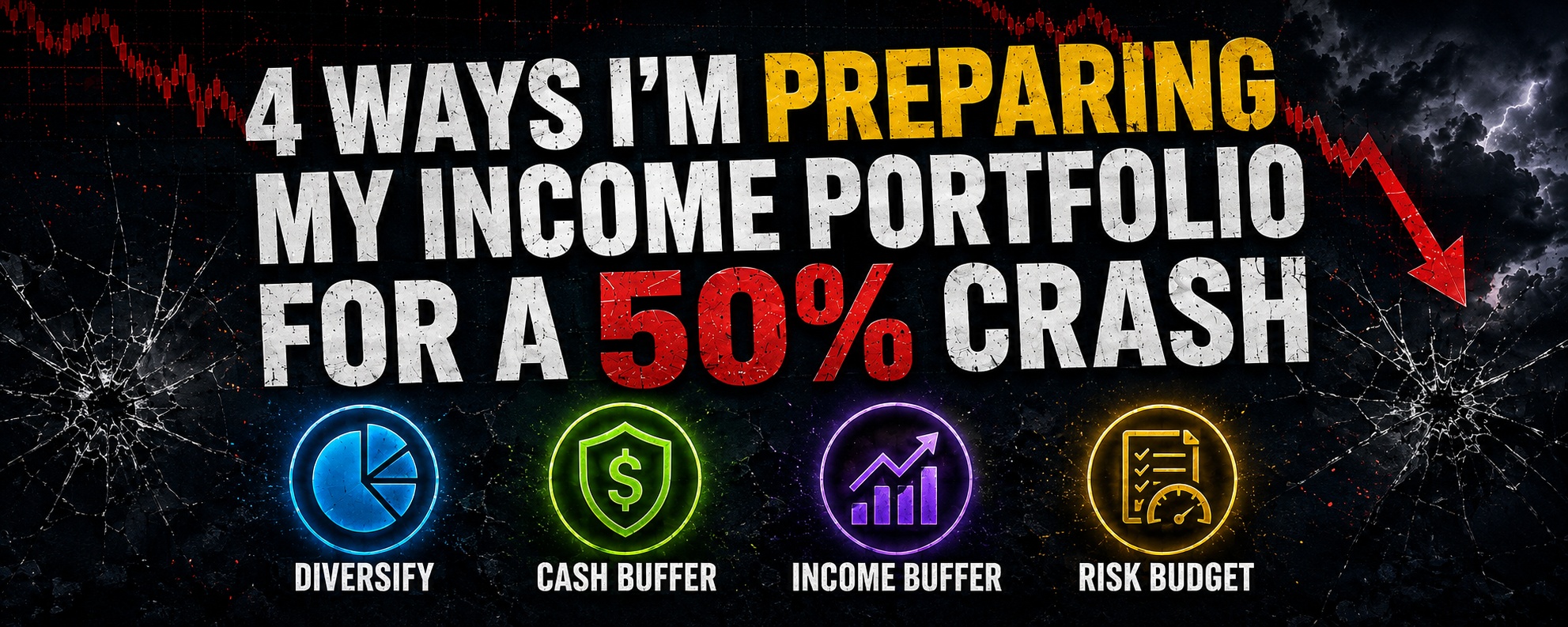
If the market fell 50% tomorrow, would your portfolio income still cover your expenses?
A 50% market decline does not automatically mean a 50% income cut.
But distributions can still fall, especially if asset values remain depressed after volatility returns to normal.
My portfolio currently produces more than $5,000 per month, and I do not treat that income as guaranteed.
Here are the four protections I am building into my plan:
1. Diversify the income engines
Owning more tickers is not the same as real diversification.
I want income coming from different assets, strategies, and fund managers, including equity options, real assets, preferred securities, closed-end funds, rate-sensitive strategies, and cash.
Different does not mean safe.
It means the entire portfolio is not dependent on exactly the same thing going right.
2. Keep a real emergency fund
I believe someone relying on variable portfolio income should consider keeping around 6 to 12 months of essential expenses readily available.
The goal is not to hold enough cash to outlast every bear market.
It is to avoid being forced to sell, borrow, or make major decisions during the worst part of the decline.
3. Produce more income than you need
If your lifestyle requires $5,000 per month and the portfolio produces exactly $5,000, there is no margin of safety.
To still have $5,000 after a 30% income cut, the portfolio would need to generate roughly $7,143 beforehand.
To still have $5,000 after a 50% cut, it would need to generate $10,000.
That is one reason my long-term $10,000 monthly goal is not only about spending more.
It is also about creating a buffer.
4. Define your personal risk budget
I am stress-testing the portfolio against a 50% market decline.
But in my personal calculations, I am currently preparing for roughly a 30% reduction in cash flow.
Could the income fall further?
Absolutely.
Thirty percent is not a prediction or a maximum loss.
It is the amount I want the current plan to absorb before I need to make more serious changes.
There is no version of early financial freedom without uncertainty.
The goal is not to build a portfolio that can never fall.
It is to build a life that does not immediately collapse when the portfolio does.
I explain the full crash plan, the income mechanics, and how I am applying it to my real portfolio here:
Full video: [https://youtu.be/KNml0Pj6A-U?si=cSoc9gQO6PX9NzsZ]
Not financial advice, just sharing how I am stress-testing and continuing to improve my own income portfolio.