
 Stock Analysis
 General
 Library
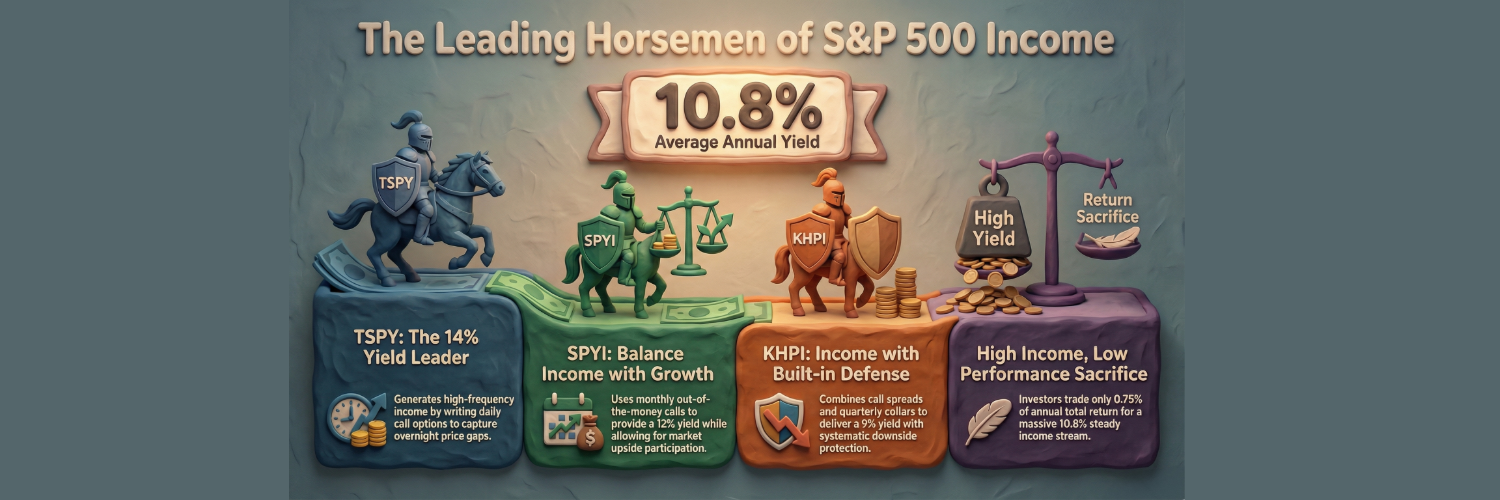
For investors seeking high income from the S&P 500 without abandoning equity exposure, a new group of option-based ETFs has emerged as consistent cash-flow generators. I call them “The Five Horsemen of Income.”
These funds take different approaches—daily call writing, put spreads, collars, volatility-adaptive call strategies—but they share one goal: steady, reliable yield on top of broad market exposure.
Together, they form a diversified income engine that has delivered an equally weighted average yield of 10.8%, far above the S&P 500’s traditional dividend yield.
Here’s how each one works—and what investors should know about the trade-offs.
1. TSPY – Daily Call Writer (14% Yield)
TSPY extracts income “a scrap at a time” by writing daily call options on the S&P 500. This allows the fund to consistently capture the overnight gap, a portion of price movement that occurs outside regular trading hours.
Pros:
Consistent daily premium collection
Reliable gap capture
Risks:
Exposed to large intraday rallies
Rapid up-moves can cause underperformance
TSPY functions almost like a high-frequency income engine—small amounts collected frequently.
2. SPYI – Monthly, Out-of-the-Money Calls (12% Yield)
SPYI writes out-of-the-money (OTM) calls with roughly 7-week expirations, rolling them at the end of each month. Importantly, SPYI does not write on 100% of its notional value.
This gives the ETF breathing room to capture partial upside when the market rallies through strike prices.
Pros:
Attractive yield with better upside participation
Designed for smoother monthly income
Risks:
Some upside is still capped
Less income than a full-coverage call strategy
SPYI is ideal for investors who want balance: income, but not at the total cost of growth.
3. OVL – Laddered Put Spreads (10.5% Yield)
OVL takes a different path, generating income through OTM put spreads. It writes spreads on about 30% of the portfolio each week across a three-week ladder.
Pros:
No upside cap
Can withstand mild or gradual pullbacks
Risks:
Put spreads amplify losses during grinding or prolonged declines
Sharp selloffs can breach multiple layers of spreads
OVL’s structure thrives in sideways or mildly rising markets—but becomes vulnerable as declines accelerate.
4. GPIX – Volatility-Adaptive Weekly Call Writing (8.5% Yield)
GPIX writes weekly call options four weeks out, but only on a small slice of the fund’s notional value. Its secret weapon is adaptability: the portion it writes changes based on market volatility.
When volatility rises, GPIX can achieve its income target while writing on less notional exposure. When volatility is low, it writes a bit more.
Pros:
Quick responsiveness to volatility shifts
Lower notional exposure during turbulent markets
Smooth, predictable income targeting 8.5%
Risks:
Lower yield than aggressive call writers
Still limits some upside
This makes GPIX one of the more risk-controlled weekly writers available.
5. KHPI – Call Spreads + Quarterly Collars (9% Yield)
KHPI uses a hybrid approach:
Call spreads to capture more upside
Quarterly collars, set about 5% out of the money, for systematic downside protection
This combination helps smooth volatility, and the available 10-year backtest suggests the strategy performs reliably through multiple market regimes.
Pros:
Superior upside capture compared to traditional covered-call funds
Downside risk control through collars
More stable long-term path
Risks:
Collars limit some gains during extreme rallies
Quarterly resets may miss rapid shifts in volatility
KHPI stands out for investors wanting income and a more defensive profile.
What the Numbers Say: Income vs. Total Return
From September 30, 2024 to March 31, 2026, the difference in total return between:
Holding SPY outright, and
Holding the Five Horsemen equally weighted
…was just 1.1%.
On an annual basis, investors traded roughly 0.75% per year of total return in exchange for a high, steady income stream averaging 10.8%.
For many retirees or income-focused investors, that trade-off is more than acceptable—it's the point.
Final Thoughts: Building an Income-Focused S&P 500 Strategy
The “Five Horsemen” are not a monolith—they use five different option strategies to pursue yield:
Daily calls
7-week OTM covered calls
Laddered put spreads
Volatility-adaptive weekly calls
Collars + call spreads
Blending them provides diversification not only in yield sources but also in risk profiles, market behavior, and volatility sensitivity.