

 Stock Analysis
 General
 Library

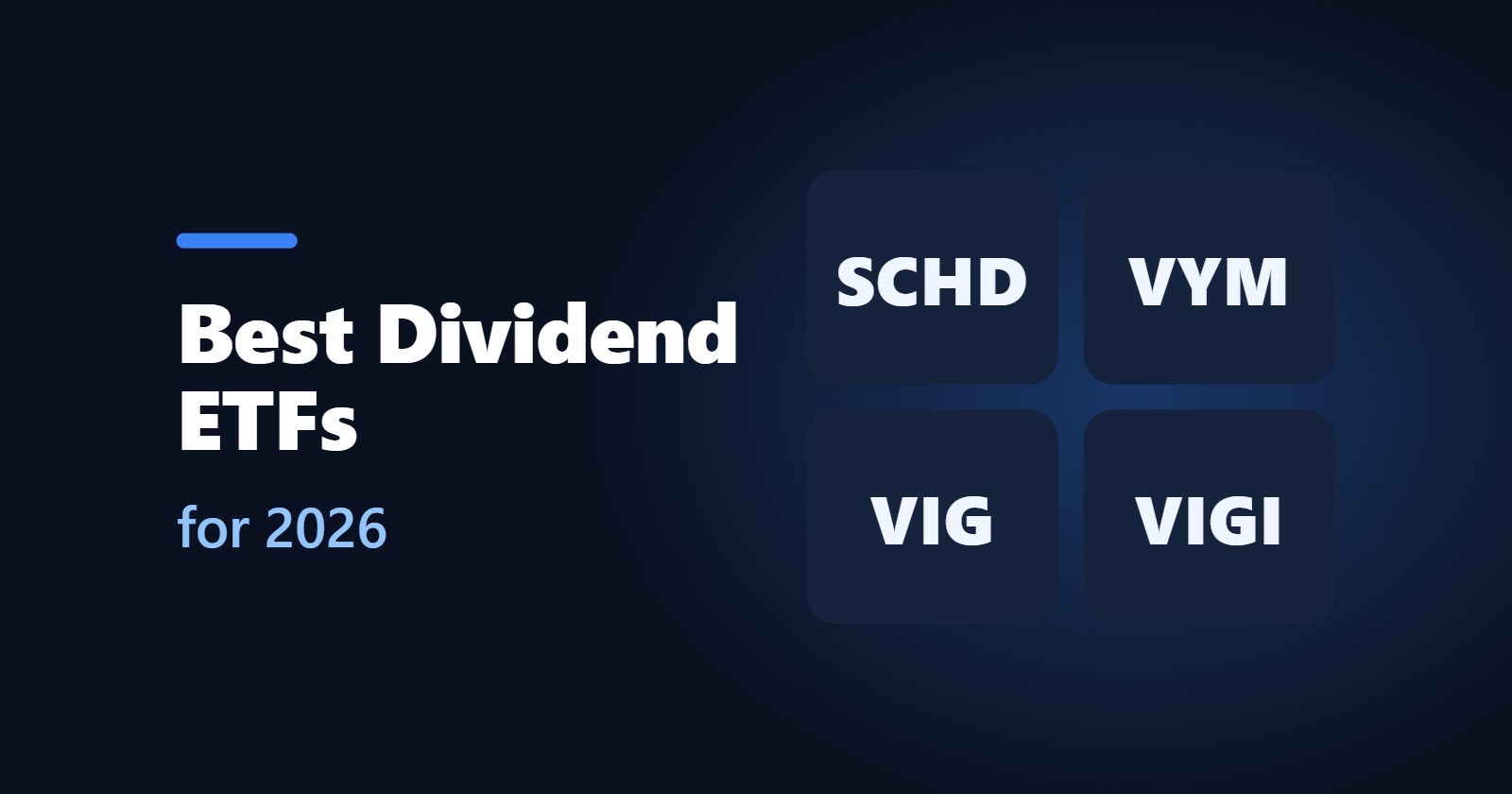
The dividend funds Morningstar's analysts keep coming back to—with today's fees, yields, and what each one actually owns.
Picking individual dividend stocks takes time: you have to track payout ratios, earnings, and dividend announcements for every company you own. A dividend exchange-traded fund does much of that work in a single holding. It spreads your money across dozens or hundreds of dividend payers, typically charges a small annual fee, and trades like a stock.
But dividend ETFs are not interchangeable. Some chase the highest yields, some focus on companies that keep raising their payouts, and some invest abroad. Two funds with "dividend" in the name can behave very differently in the same market.
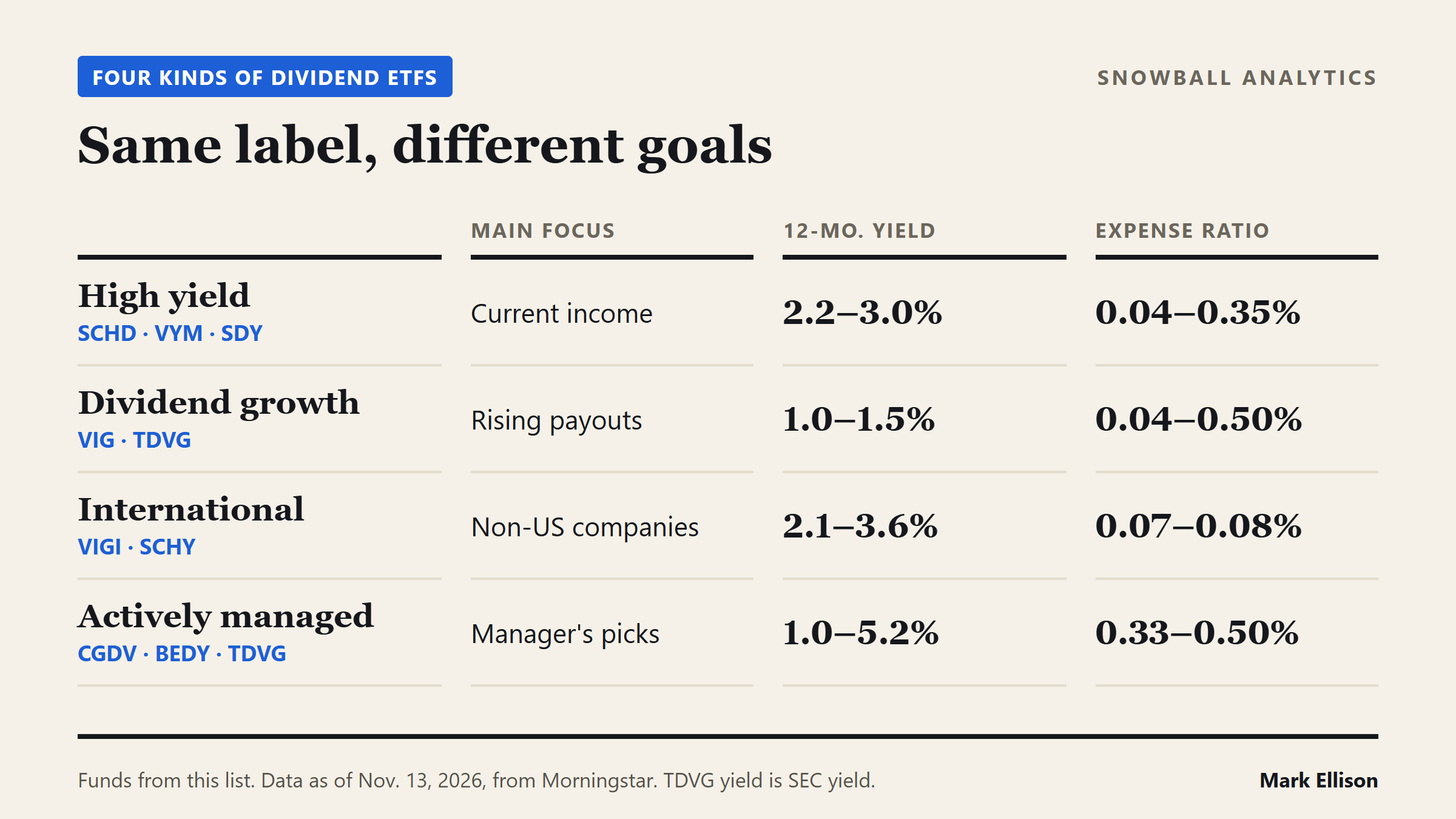
Funds from this list. Data as of Nov. 13, 2026, from Morningstar fund pages.
To cut through the choice, we looked at which dividend ETFs Morningstar's fund analysts highlight most consistently.
How We Built This List
We reviewed eight Morningstar articles on dividend funds published between 2024 and October 2026 by seven different authors, including its 2026 roundups of the top high-dividend ETFs and the best dividend funds, its international dividend ETF picks, and its income-investing coverage. Then we:
counted every time a US-listed dividend-stock ETF appeared as a highlighted pick;
left out mutual funds, bond funds, option-income funds, and broad index funds used only as benchmarks;
broke ties in favor of the fund featured most recently;
refreshed fees, yields, and assets from Morningstar's fund pages.
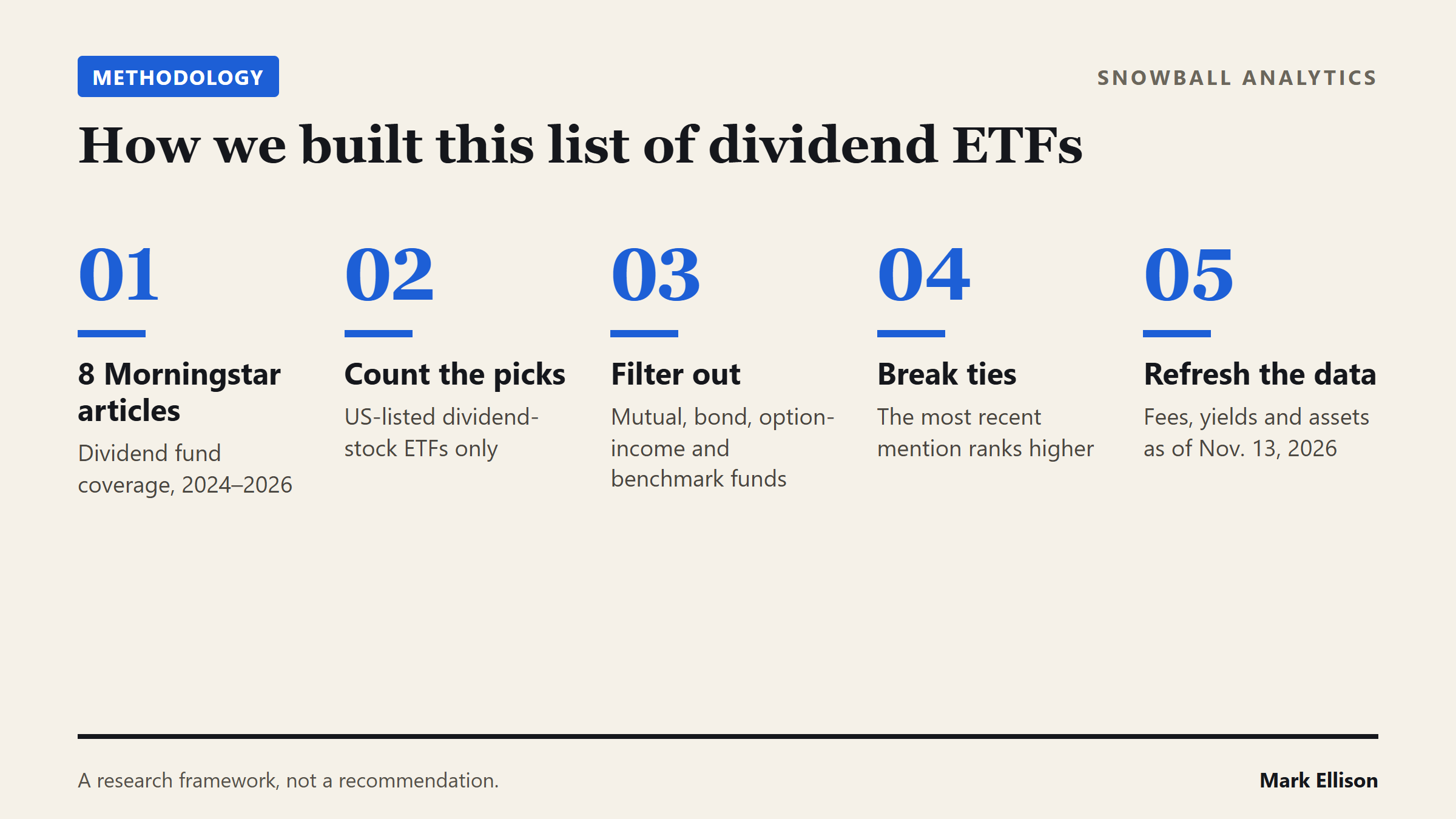
How the list was built. A research framework, not a recommendation.
Expense ratios, yields, and assets are as of November 13, 2026, from Morningstar's fund pages. Morningstar Medalist Ratings are taken from the most recent Morningstar article that names each fund. This list summarizes third-party research for educational purposes; it is not a recommendation to buy, sell, or hold any fund.
The Best Dividend ETFs for 2026
Schwab U.S. Dividend Equity ETF (SCHD)
Vanguard High Dividend Yield ETF (VYM)
Vanguard Dividend Appreciation ETF (VIG)
Vanguard International Dividend Appreciation ETF (VIGI)
Capital Group Dividend Value ETF (CGDV)
Fidelity High Dividend ETF (FDVV)
Schwab International Dividend Equity ETF (SCHY)
State Street SPDR S&P Dividend ETF (SDY)
BNY Mellon Enhanced Dividend and Income ETF (BEDY)
T. Rowe Price Dividend Growth ETF (TDVG)
1. Schwab U.S. Dividend Equity ETF (SCHD)
Featured in Morningstar articles: 6 times
Morningstar Medalist Rating: Gold
Approach: Passive · US large value
Expense ratio: 0.06%
SEC yield: 3.21% · 12-month yield: 2.95%
Assets: $123.6 billion
SCHD is probably the best-known dividend ETF among individual investors, and it ties for the most appearances in our review. It tracks the Dow Jones U.S. Dividend 100 Index, which requires at least 10 years of uninterrupted dividends and five years of dividend growth, then picks 100 companies on the strength of their finances. PepsiCo, Verizon, and Home Depot are typical of what it owns.
A Charles Schwab branch. Photo: Ajay Suresh / Wikimedia Commons, CC BY 4.0
Two things are worth understanding before relying on it. First, it's concentrated: Morningstar notes that roughly 40% of assets sit in the top 10 holdings. Second, its sector mix can shift quickly—energy went from under 2% of the fund in 2021 to more than 21% by 2025. That flexibility has paid off this year: SCHD gained 17.5% in the first half of 2026, according to Morningstar.
See SCHD's dividend history on Snowball Analytics →
2. Vanguard High Dividend Yield ETF (VYM)
Featured in Morningstar articles: 6 times
Morningstar Medalist Rating: Gold
Approach: Passive · US large value
Expense ratio: 0.04%
SEC yield: 2.23% · 12-month yield: 2.24%
Assets: $101.0 billion
VYM takes the opposite approach to concentration. It tracks the FTSE High Dividend Yield Index, which simply holds the higher-yielding half of US dividend-paying stocks (excluding REITs) and weights them by market value. The result is a broad portfolio that leans toward large, stable companies.
Morningstar director Bryan Armour says the fund strikes a good balance between higher yields and avoiding "yield traps"—stocks whose payouts look generous but can't last. Because it sweeps in so many companies, any single troubled holding has little impact, and market-cap weighting automatically shrinks a stock's weight as its price falls. Its fee of 0.04% a year is about as low as dividend funds go.
See VYM's dividend history on Snowball Analytics →
3. Vanguard Dividend Appreciation ETF (VIG)
Featured in Morningstar articles: 5 times
Morningstar Medalist Rating: Gold
Approach: Passive · US large blend
Expense ratio: 0.04%
SEC yield: 1.43% · 12-month yield: 1.47%
Assets: $135.7 billion
VIG is the largest fund on our list and the clearest example of a dividend-growth strategy. It tracks the S&P U.S. Dividend Growers Index, which only admits companies that have raised their dividends for at least 10 consecutive years—and then removes the highest-yielding names to avoid distressed companies. That leaves a portfolio of more than 300 profitable, steady businesses.
The trade-off is a modest current yield. The strict entry rule also keeps out fast-growing companies until they've built a record: Apple and ExxonMobil, for example, only joined in 2023. Investors who care more about income growing over time than about income today often pair a fund like VIG with a higher-yielding one.
See VIG's dividend history on Snowball Analytics →
4. Vanguard International Dividend Appreciation ETF (VIGI)
Featured in Morningstar articles: 5 times
Morningstar Medalist Rating: Gold
Approach: Passive · foreign large growth
Expense ratio: 0.07%
12-month yield: 2.13%
Assets: $9.5 billion
VIGI applies the same dividend-growth idea outside the US. It tracks the S&P Global Ex-U.S. Dividend Growers Index, which holds large and midsize companies from developed and emerging markets that have raised their dividends for at least seven straight years, again excluding the highest yielders.
Morningstar credits that focus on stable, profitable businesses for VIGI's resilience in downturns: in 2022, it beat the MSCI ACWI ex USA Growth Index by 5 percentage points. Keep in mind that international funds add currency risk, and dividends from foreign companies may be subject to foreign withholding taxes.
See VIGI's dividend history on Snowball Analytics →
5. Capital Group Dividend Value ETF (CGDV)
Featured in Morningstar articles: 3 times
Morningstar Medalist Rating: Gold
Approach: Active · US large value
Expense ratio: 0.33%
SEC yield: 1.28% · 12-month yield: 1.23%
Assets: $39.0 billion
CGDV is the first actively managed fund on our list, meaning a team picks the stocks rather than following an index. Capital Group's managers aim for a dividend yield roughly 30% above the S&P 500's, mostly from investment-grade companies with long dividend histories. They can also put up to 10% of assets in companies that don't pay dividends yet. Broadcom, RTX, and Microsoft are among its top holdings.
Morningstar senior analyst Stephen Welch highlights the fund's veteran managers and its 0.33% fee, which ranks among the cheapest for actively managed large-value funds. The strategy tracks a Capital Group composite dating back to 2001. Its yield is the second lowest on this list, so this is more of a quality-and-growth pick than a pure income fund.
See CGDV's dividend history on Snowball Analytics →
6. Fidelity High Dividend ETF (FDVV)
Featured in Morningstar articles: 3 times
Morningstar Medalist Rating: Gold
Approach: Passive · US large value
Expense ratio: 0.15%
SEC yield: 2.64% · 12-month yield: 2.76%
Assets: $10.6 billion
FDVV tries to balance income with growth. Its index removes stocks with the highest payout ratios—often a warning sign for future dividend cuts—then scores the rest on dividend yield, payout ratio, and dividend growth. It also shifts up to 40% of the portfolio's weight from lower-yielding sectors toward higher-yielding ones such as real estate and consumer staples.
A Fidelity Investments office in Bethesda, Maryland. Photo: Tony Webster / Wikimedia Commons, CC BY 2.0
The result is an unusual mix: according to Morningstar, the fund held nearly 13 percentage points more in technology stocks than its typical large-value peer in April 2026, yet still delivers a higher yield than average. It also holds some companies from developed markets outside the US.
See FDVV's dividend history on Snowball Analytics →
7. Schwab International Dividend Equity ETF (SCHY)
Featured in Morningstar articles: 2 times
Morningstar Medalist Rating: Gold
Approach: Passive · foreign large value
Expense ratio: 0.08%
SEC yield: 3.71% · 12-month yield: 3.55%
Assets: $2.8 billion
SCHY is essentially SCHD's international sibling, and it has the highest SEC yield of the index funds on this list. It tracks the Dow Jones International Dividend 100 Index, which narrows non-US large and midsize companies down to 100 stocks with higher yields, strong profitability and free cash flow, lower volatility, and a long record of paying dividends. REITs are excluded.

Charles Schwab's building in Omaha, Nebraska. Photo: Wikimedia Commons (public domain)
The index also limits any single stock to 4% of the fund and caps both individual sectors and emerging markets at 15%, which keeps it diversified. Morningstar associate director Daniel Sotiroff notes that the fund's profitability has consistently run above its category average, while it has tended to be less volatile.
See SCHY's dividend history on Snowball Analytics →
8. State Street SPDR S&P Dividend ETF (SDY)
Featured in Morningstar articles: 2 times
Morningstar Medalist Rating: Gold
Approach: Passive · US mid-cap value
Expense ratio: 0.35%
SEC yield: 2.30% · 12-month yield: 2.35%
Assets: $22.6 billion
SDY has one of the strictest entry rules of any dividend fund: it tracks the S&P High Yield Dividend Aristocrats Index, which only includes companies that have raised their dividends for at least 20 consecutive years. More than two-thirds of the portfolio carries a wide or narrow Morningstar economic moat rating.

One Lincoln Street in Boston, the State Street Financial Center. Photo: Garrett A. Wollman / Wikimedia Commons, CC BY-SA 2.5
Unlike most funds here, SDY weights its holdings by dividend yield rather than company size, which pushes its yield higher but can increase exposure to stocks whose prices are falling. Its defensive tilt—industrials, consumer staples, and utilities made up more than half of the fund as of June 2026—has historically helped in market downturns and lagged when growth stocks lead.
See SDY's dividend history on Snowball Analytics →
9. BNY Mellon Enhanced Dividend and Income ETF (BEDY)
Featured in Morningstar articles: 2 times
Morningstar Medalist Rating: Silver
Approach: Active · US large value
Expense ratio: 0.50%
SEC yield: 6.92% · 12-month yield: 5.21%
Assets: $350 million
BEDY is the newest and smallest fund on our list: it converted from a mutual fund into an ETF in December 2025. The team behind it has run the strategy for about 15 years, focusing on companies with positive and growing free cash flow to avoid value traps.
The Bank of New York's historic building at One Wall Street. Photo: Ken Lund from Reno, Nevada, USA / Wikimedia Commons, CC BY-SA 2.0
Its yield stands out, but there's a reason. When it became an ETF, the fund added a derivatives-based sleeve, capped at 10% of the portfolio, designed to boost income. That makes it structurally different from the other funds here, and part of its payout comes from that strategy rather than from stock dividends alone. Its 0.50% fee is higher than most passive options, though Morningstar calls it reasonable for active management.
See BEDY's dividend history on Snowball Analytics →
10. T. Rowe Price Dividend Growth ETF (TDVG)
Featured in Morningstar articles: 1 time (tie broken by most recent mention)
Morningstar Medalist Rating: Silver or Gold (on Morningstar's October 2026 list of top-rated dividend funds)
Approach: Active · US large blend
Expense ratio: 0.50%
SEC yield: 0.97%
Assets: $1.4 billion
TDVG rounds out our list as an actively managed take on dividend growth. It is the ETF version of a long-running T. Rowe Price strategy led by Tom Huber, and Morningstar noted that associate manager David Rowlett was set to become a comanager on September 30, 2026—a change it said did not affect the fund's rating.

100 East Pratt Street, T. Rowe Price's longtime headquarters in Baltimore. Photo: Toohool / Wikimedia Commons, CC BY-SA 4.0
With a yield under 1%, TDVG is built for investors who prioritize companies that can grow their dividends over the long run rather than current income. It made Morningstar's October 2026 list of the best dividend funds, which only includes funds rated Silver or Gold.
See TDVG's dividend history on Snowball Analytics →
The Best Dividend ETFs at a Glance
FundTickerStyleExpense ratio12-mo. yieldMorningstar mentions | |||||
Schwab U.S. Dividend Equity | SCHD | Passive, US | 0.06% | 2.95% | 6 |
Vanguard High Dividend Yield | VYM | Passive, US | 0.04% | 2.24% | 6 |
Vanguard Dividend Appreciation | VIG | Passive, US | 0.04% | 1.47% | 5 |
Vanguard Intl. Dividend Appreciation | VIGI | Passive, international | 0.07% | 2.13% | 5 |
Capital Group Dividend Value | CGDV | Active, US | 0.33% | 1.23% | 3 |
Fidelity High Dividend | FDVV | Passive, US + intl. | 0.15% | 2.76% | 3 |
Schwab Intl. Dividend Equity | SCHY | Passive, international | 0.08% | 3.55% | 2 |
SPDR S&P Dividend | SDY | Passive, US mid-cap | 0.35% | 2.35% | 2 |
BNY Mellon Enhanced Dividend and Income | BEDY | Active, US | 0.50% | 5.21% | 2 |
T. Rowe Price Dividend Growth | TDVG | Active, US | 0.50% | 0.97%* | 1 |
Data as of November 13, 2026, from Morningstar's fund pages. *SEC yield. Yields change over time and are not a forecast of future income.
How These Dividend ETFs Differ
Because these funds pursue different goals, comparing them on yield alone can be misleading. A few distinctions matter more:
High yield vs. dividend growth. Funds like VYM, SCHY, and SDY emphasize current income. VIG, VIGI, and TDVG focus on companies that keep raising their dividends, which usually means a lower yield today.
Passive vs. active. Most funds here track an index and charge very little. CGDV, BEDY, and TDVG rely on managers' judgment and charge more for it.
US vs. international. VIGI and SCHY invest outside the US, and FDVV holds some foreign stocks. International funds add currency risk but also exposure to companies that are often cheaper and higher-yielding than their US counterparts.
Costs add up. The difference between a 0.04% and a 0.50% expense ratio is $46 a year on every $10,000 invested, and it compounds. In a hypothetical example assuming a 6% annual return before fees, $10,000 would reach about $56,788 after 30 years at the lower fee and about $49,840 at the higher one.
Payouts are usually quarterly. None of these funds pays monthly, and ETF distributions can vary from quarter to quarter.
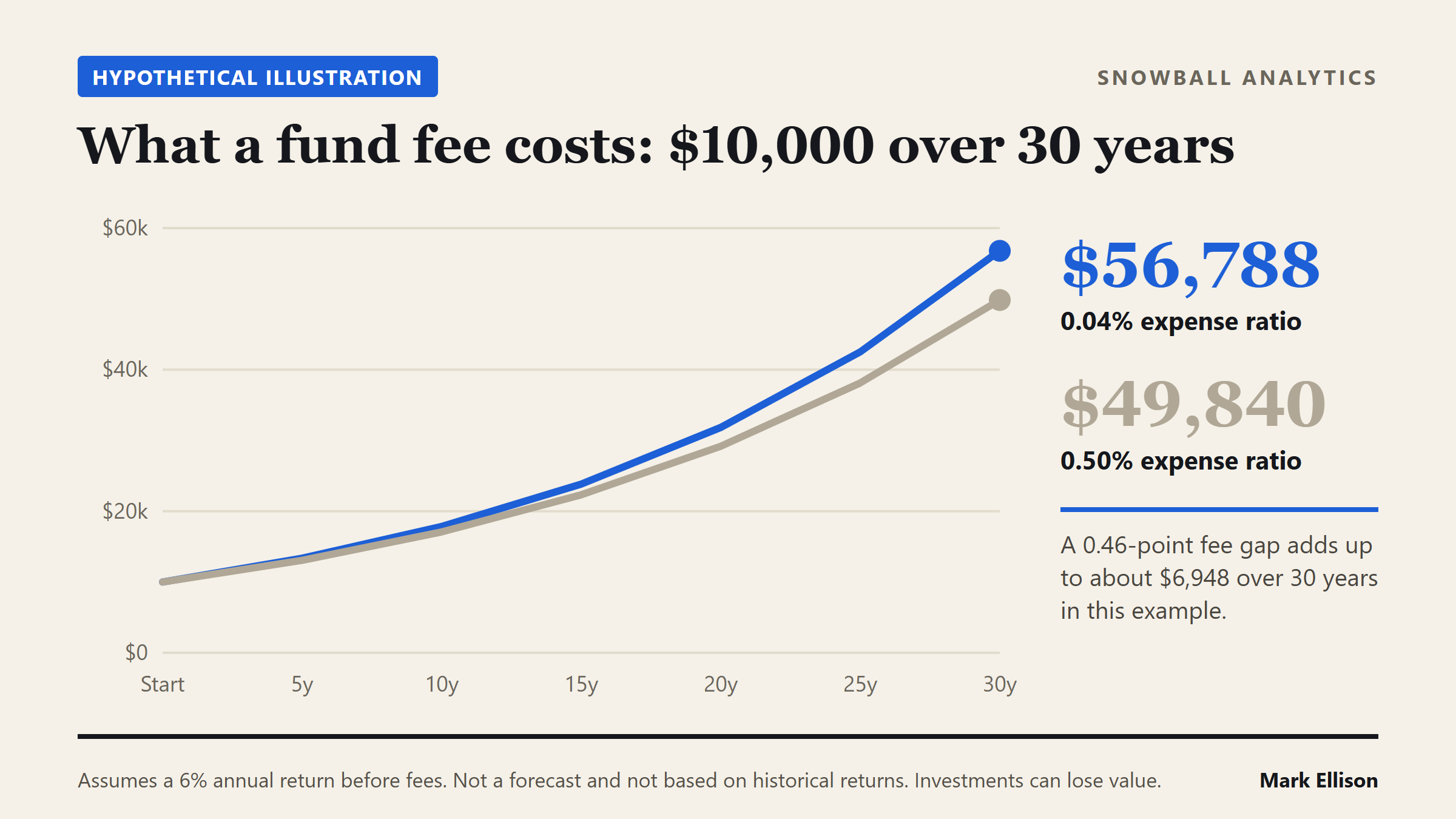
Hypothetical illustration assuming a 6% annual return before fees. Not a forecast and not based on historical returns. Investments can lose value.
Keeping Track of Your Dividend Income
Whether you hold one dividend ETF or several alongside individual stocks, it helps to see all your payouts in one place. A portfolio tracker such as Snowball Analytics can automate much of that, with a dividend calendar and dividend analytics across your brokerage accounts. You can also add these funds to a watchlist and follow their distribution history before deciding anything.
Not financial advice. This article is provided for informational and educational purposes only. It is not financial advice, investment advice, or a recommendation to buy, sell, or hold any security, and it does not take into account your personal financial situation or goals.
The funds named above are examples drawn from third-party research, including Morningstar analyst opinions and ratings, and reflect publicly available information as of the dates shown; fees, yields, ratings, and assets change frequently. Fund distributions are not guaranteed and can vary or decline. Past performance does not guarantee future results, and all investing involves risk, including the possible loss of principal. Read each fund's prospectus before investing. Tax treatment of fund distributions depends on your situation; that's a question for your tax adviser. Do your own research or consult a qualified financial professional before making investment decisions. Snowball Analytics is a portfolio-tracking tool and is not a registered investment adviser or broker-dealer.
About the Author
Mark Ellison writes about dividend investing and long-term portfolio building for Snowball Analytics. He focuses on what makes income durable—payout ratios, dividend-growth track records, and the business quality behind them—and on turning analyst research into lists everyday investors can actually use.